
The short answer
Yes, one person can run a small construction business in the USA, especially a focused excavation service built around a mini excavator and a controlled service area. The model is common, but it is not simply one person operating one machine. The owner must sell, estimate, transport, operate, maintain, invoice, and collect. Income depends on billable days, job mix, local rates, transport time, machine uptime, and debt. The useful question is: how can one person build a safe, legal, repeatable system—and what remains after every cost is counted?
01
One-person businesses are a major part of the U.S. economy
The closest official measure of a one-person company is a Census nonemployer establishment: a business with no paid employees that is subject to federal income tax. It is not a perfect synonym. A nonemployer can be a sole proprietorship, partnership, or corporation, and one owner can file more than one business return. Still, it is the most useful national benchmark for a business operated without payroll employees.
The Census Bureau counted 30,427,808 nonemployer establishments in 2023. Its construction sector included 2,917,631 of them, or about 9.6% of all U.S. nonemployer establishments. Construction nonemployers reported $246.0 billion in receipts, which works out to roughly $84,300 per establishment. That is average gross receipts, not take-home pay, and includes many construction trades beyond excavation.U.S. Census Bureau, 2023 Nonemployer Statistics
The SBA’s February 2026 FAQ uses the prior 2022 Census release and reports that 29.8 million of 36.2 million U.S. small businesses had no employees. That is 82.3%. Different release years produce different totals, but both sources show that operating without employees is mainstream rather than unusual.SBA Office of Advocacy, February 2026 FAQ
| Measure | Reference year | Count | Receipts or share | What it means |
|---|---|---|---|---|
| All Census nonemployer establishments | 2023 | 30,427,808 | $1.753 trillion receipts | Businesses with no paid employees; not necessarily one owner |
| Construction nonemployer establishments | 2023 | 2,917,631 | $246.0 billion receipts | About 9.6% of all nonemployers; covers the full construction sector |
| U.S. small businesses without employees | 2022 data in SBA 2026 FAQ | 29,811,495 | 82.3% of small businesses | SBA summary based on Census NES and SUSB data |
Counts come from Census Nonemployer Statistics and the SBA Office of Advocacy. “Nonemployer,” “sole proprietor,” and “self-employed person” are related but not interchangeable terms.
02
Construction has millions of solo tax filers, but the averages need context
IRS Statistics of Income estimated 3,368,860 nonfarm sole-proprietorship returns in construction for tax year 2023. Those returns reported $382.5 billion in business receipts and $56.7 billion in net income less deficit. Dividing the totals gives about $113,500 of receipts and $16,800 of net income per return, but neither figure predicts what a full-time excavation owner will earn.IRS Statistics of Income, 2023 Table 1
The IRS count is higher than the Census construction nonemployer count because the programs measure different universes and apply different rules. Schedule C data can include side businesses, loss-making operations, and sole proprietors that paid wages. Census nonemployer data exclude businesses with payroll. Use the IRS figures as a broad tax benchmark, not an excavation rate card.
A dedicated owner-operator with a properly priced machine may earn far more than the sector-wide average. A new operator with low utilization, high equipment debt, or part-time activity may earn less or report a loss. The national data prove the business form is common; they do not remove the need for a local job-cost model.
| IRS measure | Construction total | Derived amount per return | Use it carefully |
|---|---|---|---|
| Sole-proprietorship returns | 3,368,860 | — | Includes businesses with and without net income |
| Business receipts | $382.5 billion | About $113,500 | Gross business income before deductions |
| Net income less deficit | $56.7 billion | About $16,800 | Sector average including part-time firms and losses |
Derived averages divide IRS industry totals by returns and are rounded. They are descriptive national statistics, not expected earnings for a specific excavation company.
03
How to start a small excavation business in seven practical steps
First, confirm demand before choosing a machine. Talk with local builders, landscapers, plumbers, septic contractors, property managers, and homeowners. Identify recurring jobs that are currently delayed, overpriced, or too small for larger excavation companies. Search demand should become conversations, site visits, and written estimates before it becomes equipment debt.
Second, choose three narrow services that fit one machine and one operator. Drainage trenches, small grading jobs, stump removal, driveway preparation, utility trenches, and compact demolition can be easier to estimate than broad site-development work. Define the access limits, digging depth, material-handling needs, hauling responsibility, and exclusions for each service.
Third, build the legal and safety foundation. Check state and local contractor rules, business registration, insurance, excavation permits, utility-location procedures, and truck-and-trailer requirements. Previous operating experience does not replace a business process, and a registered business does not replace competent excavation practice.
Fourth, calculate the complete operating system: machine, attachments, truck, equipment trailer, spoil-hauling method, insurance, fuel, maintenance, repair reserve, storage, software, taxes, and working capital. Rent machines or subcontract hauling while demand is unproven. Buy only when control and utilization justify the fixed cost.
Fifth, establish a break-even hourly and day rate before accepting work. Sixth, use written scope, exclusions, deposit, change-order, and payment terms on every job. Seventh, measure estimates against actual machine hours, travel, disposal, fuel, repairs, and collection time so the second month is priced better than the first.
| Step | Decision | Proof required before moving forward |
|---|---|---|
| 1. Validate demand | Choose a tight service area and customer group | Real conversations, site visits, or quote requests |
| 2. Define services | Select three repeatable jobs | Clear scope, access limits, production method, and exclusions |
| 3. Confirm compliance | Check business, contractor, insurance, excavation, and transport rules | Written requirements from the relevant state and local authorities |
| 4. Design the equipment system | Rent, buy, or subcontract each function | Complete cost for digging, loading, transport, and spoil |
| 5. Set the minimum rate | Calculate hourly, day, and mobilization charges | Rate covers labor, direct costs, overhead, reserves, and profit |
| 6. Build the sales process | Estimate, contract, collect, and request reviews | Repeatable documents and follow-up schedule |
| 7. Review every job | Compare estimated and actual results | Job-level record of time, cost, margin, and collection |
04
Start with three different numbers
Gross revenue is every dollar invoiced. Business profit is what remains after direct job costs and overhead. Owner income may include wages for operating the machine plus profit distributions, so it should not be confused with either revenue or net margin.
That distinction matters because a solo owner performs two jobs. The operator deserves a market wage for productive labor, while the owner expects a return for accepting debt, downtime, and business risk. If the business only survives because the owner works for free, it is not profitable—it is hiding payroll.
For context, the U.S. Bureau of Labor Statistics reported a 2024 median annual wage of $58,320 for construction equipment operators. That is an employee-pay benchmark, not a promise of owner income, but it is a useful opportunity-cost test when evaluating whether self-employment is rewarding the extra risk.U.S. Bureau of Labor Statistics
05
Build revenue from billable days, not wishful annual totals
A simple revenue model is: billable days × average revenue per billable day. Use collected revenue, not quoted work, and separate pass-through materials or disposal fees when they do not carry meaningful margin.
Consider three stages rather than one forecast. A first-year operator is still proving demand and learning production time. During years one and two, repeat customers and more accurate estimating can raise utilization. After year three, a disciplined operator may command stronger rates and fill more of the calendar—but only if the local market, machine uptime, and job pipeline support it.
A 2026 Earth & Stone Division video illustrates the progression with three simple revenue models: two eight-hour days per week at $100 per hour produces $83,200 gross per year; three days per week at $1,500 per day for 40 weeks produces $180,000; and three days per week at $2,500 per day for 40 weeks produces $300,000. The creator presents these as earning-capacity levels drawn from experience, not audited industry averages or guaranteed year-by-year outcomes.
Two hundred and fifty working days does not mean 250 billable days. Estimates, travel, maintenance, rain, permit delays, collections, and gaps between projects consume the calendar. A conservative forecast is more useful than a spreadsheet in which the excavator apparently never needs a hose.
| Planning stage | Workload model | Pricing model | Calculated gross revenue | Business reality |
|---|---|---|---|---|
| Entering the industry | 2 days/week × 8 hours × 52 weeks | $100/hour | $83,200/year | Learning, underbidding, and equipment debt can leave a thin margin |
| Years 1–2 planning case | 3 days/week × 40 weeks | $1,500/day | $180,000/year | Repeat customers and better estimating improve utilization |
| Year 3+ planning case | 3 days/week × 40 weeks | $2,500/day | $300,000/year | Requires reputation, sales skill, systems, and controlled downtime |
Models reproduced from the cited Earth & Stone Division video. The creator describes capability levels rather than fixed year thresholds; the year labels are planning interpretations, not guarantees. All figures are gross revenue before fuel, insurance, repairs, transport, equipment payments, taxes, downtime, and owner compensation.
06
Estimate excavation business startup and daily operating costs
Direct job costs include fuel, hired labor, trucking, attachments, rented equipment, materials, disposal, and job-specific permits. Overhead continues whether the machine moves or not: insurance, equipment payments, yard costs, software, accounting, marketing, registrations, and administrative time.
Then add reserves. Tires, tracks, pins, hoses, undercarriage work, and major repairs are not surprises in an excavation business; only their timing is uncertain. A repair reserve converts that uncertainty into a priceable cost. The same logic applies to machine replacement and a cash buffer for slow-paying customers.
The U.S. Small Business Administration recommends separating one-time startup expenses from recurring monthly costs and including equipment, permits, insurance, professional fees, and marketing. For an excavation company, the list must also include transport and enough working capital to operate before invoices are collected.U.S. Small Business Administration
07
How much should a one-person excavation business charge?
First total annual overhead, including the owner’s target operator wage and planned reserves. Divide that number by realistic billable days. Add the average direct cost of one working day. The result is the minimum day rate before profit.
Build three prices from the same cost base. Use an hourly rate when production quantity or underground conditions are uncertain, a day rate when the customer is buying reserved machine capacity, and a fixed price only when scope, quantities, access, hauling, disposal, restoration, and change-order rules are clear. Add mobilization separately when travel, loading, and unloading are material costs. The detailed mini excavator pricing guide shows the complete rate calculation, minimum, and quote structure.mini excavator pricing guide
Example: $90,000 of annual overhead and owner compensation divided by 130 billable days equals about $692 per day. If fuel, transport, wear, and other direct costs average $360 per day, break-even is roughly $1,052. A quote at $1,250 leaves about $198 before tax and before any estimating error or scope change.
That example explains why copying a competitor’s hourly rate is dangerous. Their machine may be paid off, their truck may be newer, their disposal route may be shorter, or they may simply be pricing badly. Your rate must carry your costs.
08
A realistic profit margin is usually less dramatic than revenue
Construction benchmarks are a better guardrail than social-media revenue claims. CFMA’s 2025 benchmark, reflecting fiscal-year 2024 results, reported a 6.7% pre-tax net-income margin across participating construction companies. Foundation Software summarizes healthy contractor targets around 8% to 12% net while emphasizing that sector and company structure matter.
Use a range in the plan. At $210,000 revenue, a 6% net margin is $12,600, 10% is $21,000, and 15% is $31,500. That profit is separate from any reasonable wage already assigned to the owner’s operating labor. If no owner wage was included in expenses, the apparent profit overstates the return on ownership.
A lean, paid-down solo operation may outperform broad construction benchmarks. A debt-heavy startup, a seasonal market, or one major repair can underperform them. The benchmark is a warning light, not a guarantee.
09
Job mix controls both rates and utilization
Small excavation work can include drainage, trenching, grading, stump removal, footings, driveway preparation, utility work, pool excavation, and material handling. Each service has a different mix of production time, hauling, disposal risk, permits, and customer urgency.
The best jobs are not always those with the highest invoice. A compact drainage job close to the yard may produce more profit per calendar day than a larger project with repeated trucking and uncertain spoil. Track estimated hours, actual hours, direct costs, change orders, and collection time by job type.
Repeat builders, landscapers, plumbers, utility contractors, and property managers can reduce selling time and smooth scheduling. Customer quality moves annual income because fewer unpaid estimating hours create more billable days. Use the service-selection matrix inMost Profitable Mini Excavator Jobs
10
How to get the first excavation jobs without building a large sales team
Start with referral partners who already discover small excavation problems: plumbers, landscapers, fence installers, electricians, septic contractors, builders, property managers, and material yards. Give each partner a short service list, working radius, machine-access limits, insurance information, and a fast way to request a site visit. A clear specialty is easier to remember than “we do everything.”
For homeowners, build proof before buying broad advertising. Create a Google Business Profile, show real before-and-after photos, explain the estimate process, publish the areas served, and request a review after every completed job. Respond quickly, but do not quote drainage, trenching, demolition, or hauling from one photograph when a site visit is needed.
Track every lead source and outcome. Record whether the lead became a site visit, estimate, booked job, completed job, paid invoice, and referral. The best channel is not the one producing the most calls; it is the one producing acceptable jobs that pay on time and fit the equipment system.
11
Build the first equipment system around the jobs you can sell
A practical solo excavation setup has four functions: dig, load, move machines, and move spoil. One mini excavator handles digging. A compact loader or skid steer handles material and backfill. A tow vehicle and equipment trailer move machines. A dump trailer or subcontracted dump truck moves soil and debris.
One trailer does not automatically solve both transport jobs. An equipment trailer can move the excavator or loader, while a dump trailer carries spoil. A dump trailer rated to carry a compact machine may help on selected jobs, but payload, axle ratings, tie-downs, loading geometry, tow rating, and state rules must all work together. Price the complete truck-and-trailer system before buying the machine.
Before buying, compare ownership with renting or subcontracting. Ownership offers availability and control, but it also creates fixed payments and repair exposure. Renting can protect cash while demand is being proven. Subcontracting trucking or specialized work can keep the core operation focused.
Match machine size to access, lift needs, digging depth, transport limits, and the jobs that actually exist in the local market. A cheap machine that requires a truck-and-trailer upgrade may be the expensive option once the complete system is priced.
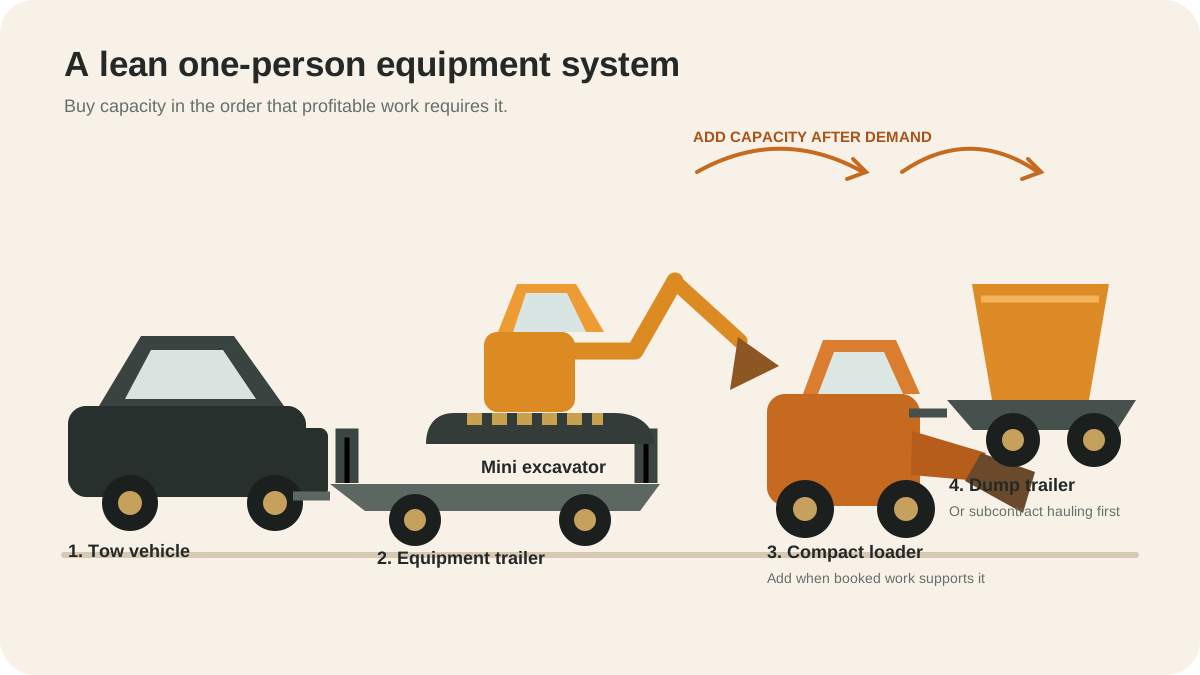
| Equipment | Primary job | Day-one decision | Solo operating limit |
|---|---|---|---|
| Mini excavator | Digging, trenching, grading, demolition with attachments | Core machine for a focused excavation service | Cannot efficiently carry spoil over distance |
| Compact loader or skid steer | Loading, backfilling, grading, material handling | Buy only when booked work supports two-machine productivity | The owner can operate only one machine at a time |
| Tow vehicle plus equipment trailer | Move the excavator or loader legally | Required if delivery is not subcontracted | Combined weight can trigger state and federal compliance |
| Dump trailer or subcontracted dump truck | Remove soil and debris; deliver aggregate | Subcontract first when hauling demand is irregular | A separate haul cycle can leave the jobsite idle |
| Attachments and support kit | Buckets, thumb, compactor, chains, tie-downs, grease and field tools | Choose from the first three profitable services | Unused attachments still create payments and maintenance |
The leanest starting package is usually one mini excavator, essential attachments, and legal transport. Add the loader and dedicated spoil-hauling capacity only when they increase completed profitable work.
12
A solo owner needs a two-calendar operating system
Separate production time from business time. Reserve blocks each week for site visits, estimates, maintenance, invoices, collections, and bookkeeping. If every daylight hour is sold to machine work, quoting stops, invoices age, maintenance slips, and the next week develops holes.
Keep the service area tight and group work geographically. Travel, loading, unloading, fuel stops, disposal, and equipment cleaning are real production costs even when the customer only notices bucket time. A smaller nearby job can outperform a larger distant job after the whole calendar day is counted.
Use subcontractors as capacity valves rather than pretending one person can be in two machines. Hauling, traffic control, utility locating, specialized compaction, licensed trade work, and extra labor can be bought per job. Define scope, insurance, scheduling, and payment responsibility in writing before work starts.
13
Legal transport and recordkeeping belong in the business model
Licensing, contractor registration, excavation permits, insurance, and vehicle rules vary by state and locality. Check the destination state and local agencies before advertising regulated work. The IRS also notes that sole proprietors may face state and local licenses and fees in addition to federal Schedule C and self-employment tax obligations.IRS Schedule C instructions
Transport rules depend on the complete combination, not the excavator alone. FMCSA states that companies using a vehicle or combination rated at 10,001 pounds or more in interstate commerce may need a USDOT number. CDL thresholds, intrastate registration, medical qualification, inspections, hours-of-service rules, and insurance can add further requirements. Verify the actual truck, trailer, cargo, route, and home-state rules before moving equipment.Federal Motor Carrier Safety Administration
Record every lead, estimate, job, machine hour, fuel purchase, repair, haul, disposal ticket, invoice, and payment. IRS sole proprietors normally report business profit or loss on Schedule C and calculate self-employment tax on Schedule SE. Quarterly estimated-tax planning prevents a profitable season from becoming a cash crisis at filing time.IRS Schedule C instructions
14
Calculate owner income with a four-line model
Use this sequence: collected revenue minus direct job costs equals gross profit; gross profit minus overhead equals operating profit; operating profit minus interest and taxes equals net profit; owner income equals wages paid for labor plus permitted profit distributions.
Run a conservative, expected, and strong case. Change billable days, average day revenue, fuel, repair reserve, and debt service in each case. If the conservative case cannot cover payments and the owner’s basic wage, the equipment package is too expensive or the market has not been proven.
The most useful target for year one is not maximum revenue. It is accurate job costing, positive cash flow, a growing base of repeat customers, and enough reserve that one repair does not decide whether the business survives.
15
Related equipment
Related equipment
A solo operator should normally begin in the compact class. Use the larger excavator and wheel-loader examples below as comparison points for the stage when booked work, transport capacity, and cash flow justify moving beyond a mini-excavator setup.
Used Kubota U35 Mini Excavator
Kubota U35 mini excavators for sale from China, with tight-access working range, year and hours guidance, inspection proof, and container shipping support.
Used Caterpillar 320 Excavator
Used Caterpillar 320 excavators for sale from China, with price bands by year and hours, inspection proof, and shipping planning before you request a quote.
Used Caterpillar 950 Wheel Loader
Used Caterpillar 950 wheel loaders for sale from China, with payload and bucket guidance for yard and loading work, inspection proof, and freight planning.
16