
The short answer
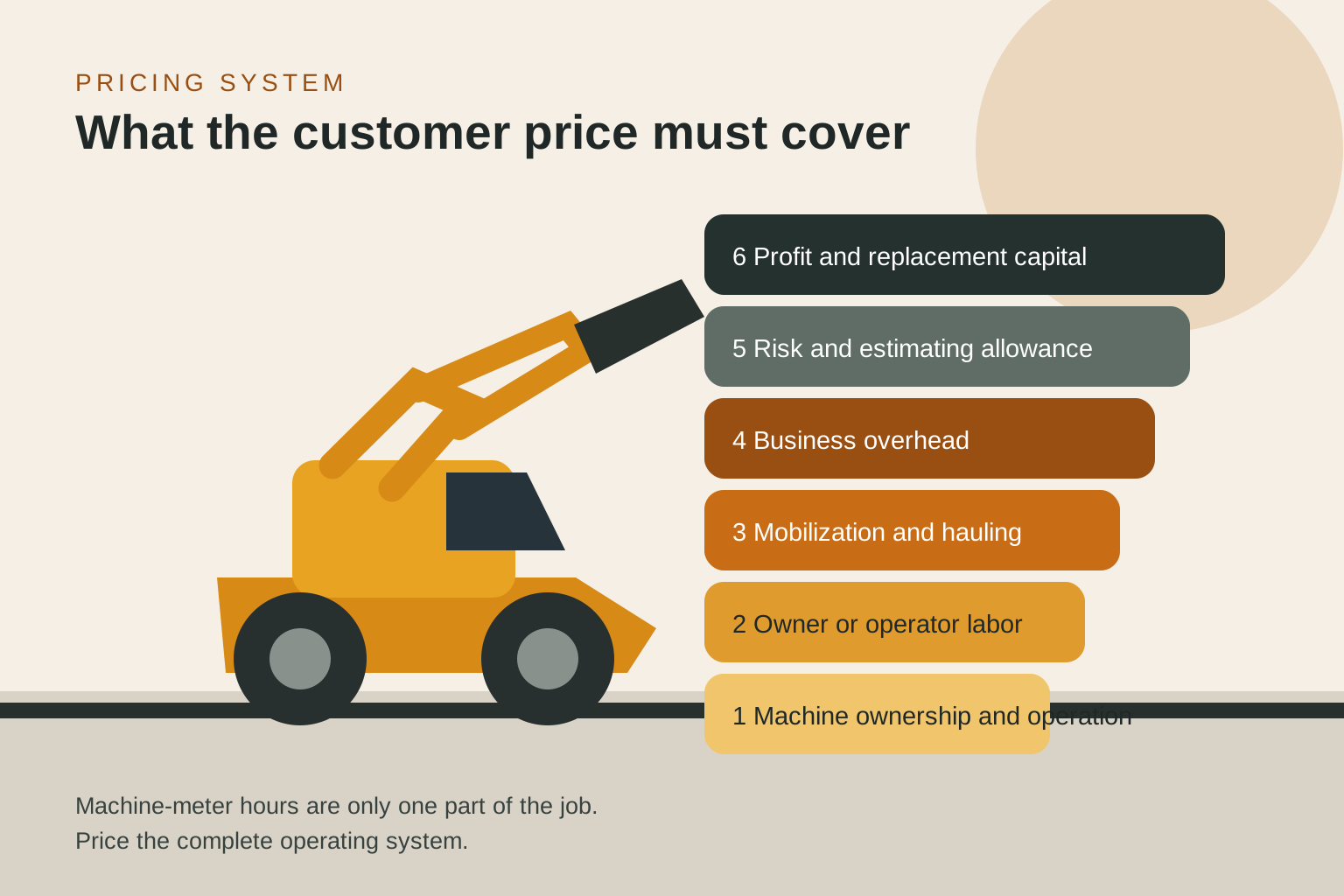
Many U.S. owner-operators currently use roughly $100 to $150 per hour as a market-check range for a mini excavator with an operator, often with a minimum charge and separate mobilization. That is not a universal rate. Your correct price is the amount that covers the machine, owner labor, truck and trailer time, overhead, job-specific costs, risk, and profit at the number of hours you can actually bill. For a new business, calculate that cost-based floor first, compare it with local quotes, and use hourly, day, or fixed pricing according to how predictable the work is.
01
Start with a price range, but do not copy it
Published U.S. pricing guides commonly place an operated mini excavator around $90 to $150 per hour, and one current contractor price list publishes $150 per hour for a mini excavator or skid steer. These are market observations, not an official national average. Machine size, location, travel, operator skill, insurance, soil, attachments, disposal, and scope can move a defensible price well outside that band.AHM mini excavator pricing guideChamberlain Backhoe Service price list
Treat competitor prices as a final reasonableness check. A contractor with a paid-off machine, a short service radius, and repeat work has a different floor from a new owner carrying equipment, truck, trailer, insurance, and financing. Matching the lowest visible rate can keep the calendar full while the business loses cash.
For the complete startup context behind equipment, customers, expenses, and owner income, use the small excavation business guide. This article owns the narrower decision: how to turn those costs into a quote.small excavation business guide
02
Separate your cost rate from your selling rate
Your cost rate is what one billable hour must recover before profit. Your selling rate is what the customer pays. They are not the same number. The gap must fund profit, slow periods, estimating errors, and future replacement capital.
The U.S. Small Business Administration defines break-even using fixed costs, selling price, and variable cost. For an owner-operator, the practical hourly version is: fixed cost per billable hour plus variable machine cost plus owner labor plus job overhead. Then convert that cost floor into a selling price using the desired margin.SBA break-even guidance
Use billable hours, not the 2,080 hours in a full work year. Rain, maintenance, quoting, travel, loading, customer delays, collections, and seasonal demand reduce the hours the machine can actually earn. Dividing annual fixed costs by an unrealistic utilization target creates an artificially low rate.
| Cost bucket | Examples | How to recover it |
|---|---|---|
| Machine ownership | Payment or depreciation, insurance, registration, storage | Annual cost divided by realistic billable machine hours |
| Machine operation | Fuel, filters, tracks, teeth, grease, repairs | Per-hour record plus a repair reserve |
| Owner or operator labor | Operating, loading, cleanup, inspection | Required hourly compensation plus employment burden where applicable |
| Truck and trailer | Payment, insurance, tires, fuel, inspection, loading time | Mobilization fee or allocated hourly/day recovery |
| Business overhead | Phone, software, bookkeeping, marketing, licenses | Annual overhead divided by realistic billable hours |
| Job-specific cost | Attachments, disposal, stone, helper, permit, traffic control | Separate line item or explicit allowance |
Do not hide disposal, materials, or subcontractors inside the machine rate when their quantities change by job.
03
Use public equipment rates as a cost check, not your customer price
FEMA’s 2025 Schedule of Equipment Rates lists a Caterpillar 305 CR hydraulic excavator at $57.14 per operating hour. FEMA explains that its schedule covers eligible ownership and operating costs such as depreciation, maintenance, field repair, fuel, lubricants, tires, and incidental equipment costs. Operator labor is excluded.FEMA 2025 Schedule of Equipment RatesData.gov FEMA equipment-rate description
That $57.14 is useful evidence that the machine itself has a real hourly cost even before the operator, truck, trailer, sales time, general business overhead, job risk, and profit are added. It is a disaster-reimbursement schedule for applicant-owned equipment—not a retail price list and not permission to quote every compact excavator at the same rate.
Labor must also be treated as a business cost. The Bureau of Labor Statistics reported a $58,320 median annual wage for construction equipment operators in May 2024. An owner’s billable labor rate must be higher than an employee wage if it also has to support nonbillable time, payroll burden, benefits, and business risk.BLS Construction Equipment Operators
04
A worked rate example shows why cheap hourly prices fail
The example below is a planning model, not a national benchmark. Replace every assumption with your own invoices, annual budget, service area, and expected utilization. The most sensitive input is often billable machine hours: owning the machine for a year does not mean selling eight machine hours every weekday.
Assume annual fixed machine and business costs of $36,000 and 600 billable machine hours. Fixed-cost recovery is $60 per billable hour. Add $28 for fuel, wear, maintenance, and repair reserve; $35 for owner labor; and $15 for administrative and truck/trailer recovery not billed separately. The internal cost floor is $138 per hour.
If the target is a 15% margin on sales, divide $138 by 0.85. The resulting selling rate is about $162 per hour before job-specific materials, disposal, rented attachments, helpers, permits, or unusual risk. If local customers will not accept that rate, the answer is not automatically to charge less. Test utilization, debt, service radius, job mix, and scope before deciding whether the operating model works.
| Input | Example | Calculation |
|---|---|---|
| Annual fixed machine and business costs | $36,000 | Input assumption |
| Realistic annual billable machine hours | 600 hours | Input assumption |
| Fixed-cost recovery | $60/hour | $36,000 ÷ 600 |
| Variable machine cost | $28/hour | Fuel, wear, maintenance, repair reserve |
| Owner labor | $35/hour | Required operator compensation |
| Other hourly recovery | $15/hour | Admin and transport cost not billed separately |
| Internal cost floor | $138/hour | $60 + $28 + $35 + $15 |
| Selling rate at 15% margin | $162/hour | $138 ÷ (1 − 0.15), rounded |
Markup and margin are different. Adding 15% to $138 produces $158.70, which is only about a 13% margin on the selling price.
05
Define machine time before the first hour is billed
Machine time usually means the excavator hour meter: the engine is running and the machine is operating or idling. It is useful for maintenance, fuel, utilization, and internal cost records. It should not be the only record used to invoice a customer unless the quote explicitly says billing is based only on meter hours.
Jobsite time can start when the truck arrives, when unloading begins, when the machine is ready to work, or when excavation starts. Those definitions produce different invoices. Write down the trigger, the billing increment, the minimum, and whether setup, attachment changes, cleanup, customer delays, and standby are billable.
A practical owner-operator system records five clocks: excavator meter start and finish, operator jobsite time, mobilization time, standby time, and total calendar time committed. The customer may see a simple hourly or fixed price, while the contractor keeps all five records to learn whether the job was actually profitable.
| Time record | What it measures | Typical pricing treatment |
|---|---|---|
| Machine-meter time | Engine hours from the excavator hour meter | Internal machine cost; billable only as defined in the quote |
| Operator jobsite time | Inspection, setup, operating, handwork and cleanup | Included in operated rate or charged as labor |
| Mobilization time | Loading, tie-down, travel, unloading and return | Separate mobilization fee or portal-to-portal billing |
| Standby time | Machine and operator held because the site cannot proceed | Reduced standby rate or full rate according to written cause |
| Calendar time reserved | Half or full day unavailable to other customers | Minimum, half-day or full-day charge |
Photograph the hour meter at arrival and departure when machine time affects the invoice. Keep the readings with the job record.
06
Charge mobilization for the calendar time the job consumes
Mobilization includes scheduling, loading, tie-down, truck and trailer travel, unloading, site access, return travel, cleanup, and the chance that a short appointment prevents another booking. The excavator meter may show two hours while the business gives up most of a day.
Use one consistent method: a service-zone fee, portal-to-portal time, a mileage and labor formula, or a half-day/full-day minimum. State whether the fee covers one move in and one move out. Extra moves, customer-caused delays, rejected access, or a second trip should have written treatment.
Current contractor discussions repeatedly emphasize separate mobilization or half-day/full-day charges for short work. They also show wide regional disagreement, which is exactly why the fee should come from your truck, trailer, labor, distance, and lost scheduling capacity—not a copied national number.Reddit discussion of 2025 billable construction ratesReddit excavation market-rate discussion
07
Choose hourly, day, or fixed pricing based on uncertainty
Hourly pricing protects both parties when hidden rock, roots, groundwater, utilities, owner changes, or uncertain quantities control production. Give the customer the rate, minimum, expected range, and conditions that can extend time.
A day rate works when the customer is buying a reserved crew-and-machine day and the work can continue productively. Define the included hours, travel, fuel, breaks, attachments, overtime, and what happens if access or another trade stops production.
Fixed pricing works best after you have production history for a clearly defined result. Build it internally from estimated labor and machine time, mobilization, materials, disposal, subcontractors, overhead, contingency, and profit. Never use “fixed price” to mean “all unknowns are free.”
| Method | Best fit | Main protection to write down |
|---|---|---|
| Hourly | Unknown ground, diagnostic digging, changing scope | Minimum, billing increments, delay and change terms |
| Half day or full day | Reserved calendar block with productive work available | Included hours, overtime, travel and attachments |
| Fixed price | Repeatable scope with verified quantities and access | Assumptions, exclusions, allowances and change orders |
| Unit price | Repeated measurable work such as feet of trench or holes | Depth, soil, access, restoration and minimum quantity |
The customer-facing quote may be fixed even when the contractor builds it from an internal hourly cost model.
08
Set a minimum charge before accepting small jobs
A minimum charge protects loading, travel, setup, cleanup, invoicing, and the calendar slot. It can be stated as a two-, three-, or four-hour minimum; a half-day package; or mobilization plus a minimum number of machine hours. Choose the format customers can understand and your scheduling system can enforce.
Example: a $160 hourly rate with a three-hour minimum and a $250 mobilization fee creates a minimum scheduled charge of $730 before disposal, materials, permits, attachments, or tax. That does not mean every three-hour job earns excess profit. It means the business is paid for committing the equipment system and time.
Tell the customer what can be completed during the minimum if the primary task finishes early. Grouping a second stump, a short drainage run, or rough cleanup can increase perceived value without discounting mobilization.
09
Price attachments, hauling, materials, and risk separately
A breaker, auger, compaction wheel, thumb, specialty bucket, or rented attachment changes wear, setup, transport, and productivity. Price it as an hourly adder, day charge, rental pass-through with handling, or fixed allowance. Name the attachment so the customer can see what the charge buys.
Spoil hauling and disposal should rarely disappear inside the excavator rate. State truck capacity, included loads, disposal assumptions, waiting time, contaminated or unsuitable material exclusions, and who owns excess volume. Do the same for stone, pipe bedding, topsoil, seed, compaction, and restoration.
Select services where compact access, a clear outcome, and controlled support costs create an advantage. The profitable-jobs guide compares drainage, footings, stump work, auger work, demolition, grading, and haul-heavy scopes.profitable mini excavator jobs guide
10
Write a quote that controls scope before work begins
A useful quote names the result, access assumptions, machine and attachments, included labor, estimated or included hours, mobilization, materials, spoil destination, restoration level, payment timing, and exclusions. It also states how changed conditions become a written change order.
For trenching, identify utility-locate responsibility, expected depth and width, bedding, pipe or conduit responsibility, compaction, surface repair, rock, groundwater, and whether anyone will enter the excavation. For stump work, define root chasing, haul-off, backfill, and lawn restoration. For grading, define rough versus finish grade and tolerances.
Give the customer a total estimated range when billing hourly. A naked hourly rate is hard to compare and encourages price shopping; a scope plus assumptions shows what the customer is actually buying.
| Quote field | What to state |
|---|---|
| Scope | Specific result, quantities, depth, dimensions and finish condition |
| Price method | Hourly, day, fixed or unit price; minimum and billing increment |
| Mobilization | Included moves, service area, extra-trip and delay rules |
| Included resources | Machine, operator, helper, attachments and truck |
| Pass-through costs | Materials, disposal, permits, rentals and subcontractors |
| Unknowns | Rock, water, utilities, buried debris, access and changed quantities |
| Completion and payment | Schedule assumptions, deposit, progress billing and final payment |
11
Track estimate versus actual after every job
Record inquiry and estimating time, loading, travel, setup, machine hours, hand labor, fuel, attachment wear, repair events, material, trucking, disposal, cleanup, invoicing, collection, and callbacks. Compare those actuals with the quote before changing the rate.
Review by service, not only by month. Drainage may support a higher effective rate because the outcome is valuable and referrals repeat. Haul-heavy clearing may show a large invoice but poor contribution after truck cycles and disposal. Your best hourly price is only useful when the selected jobs can carry it.
After ten similar jobs, update production assumptions, minimums, mobilization zones, exclusions, and contingency. A measured pricing system becomes more accurate; a copied rate stays a guess.
12
Use a simple decision rule before sending the quote
First, confirm that the quote exceeds the cost floor at realistic production. Second, verify that mobilization and calendar loss are recovered. Third, separate variable quantities and unknown conditions. Fourth, compare the effective rate with credible local competitors. Fifth, confirm that the customer-facing scope explains the result, not just machine time.
If the price looks high, do not remove profit first. Reduce travel, debt, idle time, disposal exposure, or scope uncertainty. If the price looks low, check whether owner labor, replacement capital, truck and trailer, repair reserve, and nonbillable time were omitted.
Compare machine size and transport needs before locking in overhead. A compact excavator that fits the booked work and hauling system can produce a healthier rate than a larger machine with unused capacity.compare used mini excavators
13
Related equipment
Related equipment
Your rate depends on the machine and transport system you actually own. Compare operating weight, digging depth, access width, auxiliary hydraulics, attachments, truck and trailer requirements, condition, and expected utilization before setting fixed overhead.
Used Kubota U35 Mini Excavator

Kubota U35 mini excavators for sale from China, with tight-access working range, year and hours guidance, inspection proof, and container shipping support.
Used Bobcat E35 Mini Excavator

Bobcat E35 mini excavators for sale from China, compact machines for tight-access jobs, with year and hours guidance, inspection proof, and shipping support.
14