
The short answer
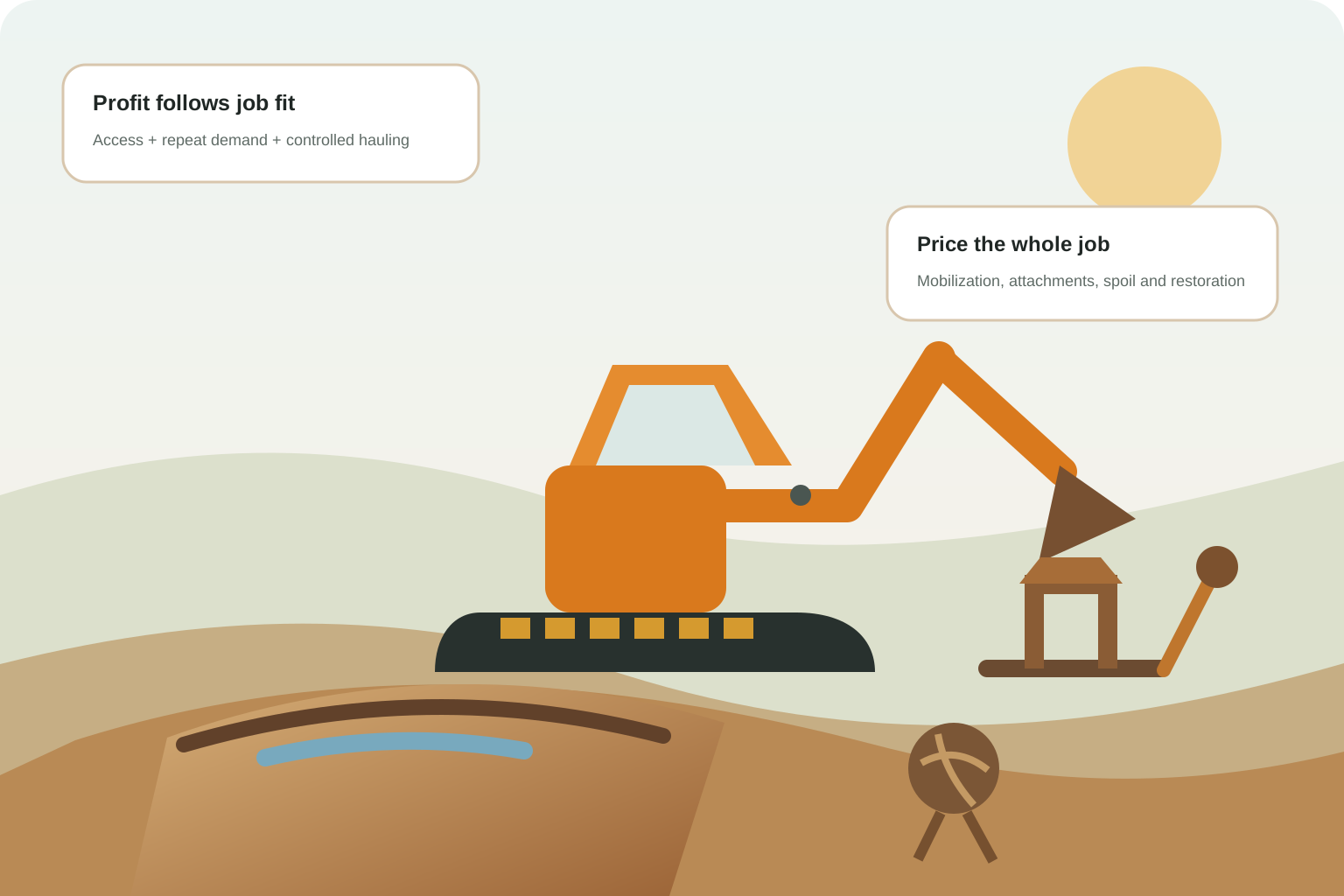
The most profitable mini excavator jobs are usually drainage and short utility trenches, tight-access footings and site preparation, stump and root removal, auger or post-hole work, and selected small demolition. But no job type is automatically profitable. Margin depends on demand, mobilization, attachments, spoil handling, restoration, site risk, and whether one operator can finish the complete scope without leaving the machine idle. The right question is not “Which job pays the most?” It is “Which job leaves the most after every required task and risk is priced?”
01
A profitable mini excavator job has five characteristics
First, the customer has a specific problem with a clear outcome: water must drain, a footing must be opened, a stump must disappear, or a utility trench must reach a defined point. Second, compact access creates an advantage over larger contractors. Third, mobilization can be recovered through a minimum charge or a package of related work. Fourth, hauling, restoration, and unknown ground conditions are controlled. Fifth, the owner can complete most of the scope without keeping a second machine or crew waiting.
High hourly production does not guarantee high profit. A two-hour dig with two hours of loading, travel, unloading, cleanup, and invoicing consumes most of a day. A larger invoice can perform worse if it includes repeated dump runs, imported material, handwork, permits, or a callback that was never priced.
Use contribution margin rather than revenue to compare services: collected job price minus the variable costs caused by that job. Then confirm that the remaining contribution can carry monthly fixed costs and owner compensation. The U.S. Small Business Administration uses the same fixed-cost, selling-price, and variable-cost logic in its break-even guidance.U.S. Small Business Administration break-even guidance
02
Compare job profit potential before choosing your service list
This matrix is a service-selection tool, not a national rate sheet. “High potential” means the job can combine compact-machine fit, clear customer value, and controlled support costs. Local soil, disposal fees, competition, permits, insurance, equipment debt, and operator skill can move any row up or down.
| Job type | Potential | Why a mini fits | Main margin leak | Best commercial condition |
|---|---|---|---|---|
| Drainage and short utility trenches | High | Precision and backyard access; repeat referrals | Utility risk, slope, bedding, restoration, trench protection | Partner work from plumbers, landscapers, builders, and drainage specialists |
| Tight-access footings and small site prep | High | Works close to structures and through narrow access | Spoil, compaction, layout errors, hand finishing | Defined drawings, short haul path, separate compaction scope |
| Stump and root removal | Medium–high | Digging force, reach, thumb compatibility | Root spread, disposal, underground services, lawn repair | Stumps grouped by mobilization with disposal priced separately |
| Auger and post-hole work | Medium–high | Attachment changes digging into repeat hole production | Rock, wrong layout, attachment cost, cleanup | Verified layout, minimum charge, repeat fence or deck partners |
| Selected small demolition | Medium–high | High perceived value in confined spaces | Disposal, permits, utilities, dust, hidden reinforcement | Known material, controlled access, disposal and exclusion terms |
| Landscape excavation and rough grading | Medium | Versatile digging and shaping | Material moving, imported fill, finish tolerance, loader dependency | Packaged with drainage, planting, retaining wall, or hardscape prep |
| Ponds and larger bulk excavation | Low–medium | Useful when access blocks larger machines | Low production, long cycle time, trucking, water and soil risk | Access is the constraint and haul/spread plan is already solved |
| Haul-heavy clearing and debris removal | Low for a solo mini-only setup | Can pull roots and load small quantities | Truck cycles, disposal fees, hand sorting, machine idle time | Priced with subcontracted hauling or a complementary loader |
Potential describes operating fit, not guaranteed profit. Validate each service with local quotes, actual production records, and job-level cost tracking.
03
Drainage and short trenches can create the strongest referral engine
French drains, downspout drainage, irrigation lines, water services, electrical conduit, and short plumbing trenches solve urgent, visible problems. A mini excavator can work in yards and narrow access where a larger excavator creates more restoration. The commercial advantage grows when a plumber, landscaper, electrician, waterproofing contractor, or builder can send repeat work.
The profitable scope is more than bucket time. Quote mobilization, layout responsibility, utility locating, trench depth and width, bedding, pipe or conduit responsibility, imported stone, spoil destination, compaction, surface restoration, and what happens if rock, groundwater, or unidentified services appear. If those tasks are left vague, a simple trench becomes several unpaid services wearing one invoice.
Every dig requires a locate process. The national 811 service directs anyone planning to dig to contact the appropriate state 811 center, wait for responses, and confirm that utilities have responded before work begins.811 Before You Dig
04
Tight-access footings and small site preparation reward precision
Deck and addition footings, retaining-wall preparation, small slabs, shed pads, steps, and narrow residential additions can favor a compact machine. The customer is paying for controlled access and reduced disturbance as much as excavation volume. Builders and hardscape contractors can also provide repeat work if layout, schedule, and cleanup are reliable.
Profit disappears when the quote covers excavation but not the rest of the production chain. Clarify who establishes grade and layout, where excavated material goes, whether stone or fill must be imported, who compacts, how close the machine can work to structures, and what finish tolerance is expected. A mini excavator digs well; it is not automatically the fastest machine for spreading and finish grading.
Bundle compatible work during one mobilization. Opening a footing, moving one planned stockpile, placing drainage stone, and preparing a nearby trench may produce a better day than four unrelated “quick digs” across a wide service area.
05
Stump removal works best when disposal and restoration are separate decisions
Stump and root removal has clear homeowner value, and a hydraulic thumb can improve handling. It also creates some of the widest estimating errors. Visible trunk diameter does not reveal the root plate, buried rocks, old wire, nearby utilities, irrigation, access damage, or the volume that must leave the property.
Quote a minimum mobilization and group multiple stumps when possible. Define whether the price includes extraction only, root chasing, loading, haul-off, imported topsoil, rough backfill, seed, or finished lawn restoration. If the customer can keep the stump and spoil in an approved on-site location, the economics can change materially.
Avoid promising a fixed completion time from a photograph. Ask for access width, stump species if known, trunk diameter, cut height, nearby structures, overhead clearance, slope, utility status, and the intended finished condition.
06
Auger and post-hole work can turn one attachment into a focused service
Fence, deck, sign, and small foundation contractors need repeated holes with consistent layout. An auger can create a focused service that is easier to schedule than broad excavation, especially when a partner supplies marked locations and repeat volume. The machine also retains its bucket for cleanup or difficult starts.
Price the attachment, teeth, wear, setup time, spoil handling, and the risk of rock or buried obstructions. State whether the price is per hole, per mobilization plus production, or a day rate with a minimum. Define who owns layout accuracy and what happens when ground conditions prevent the specified diameter or depth.
This work is attractive when holes are grouped. One isolated hole with a long drive is still a mobilization job, even if the auger turns for only a few minutes.
07
Small demolition pays for control, but disposal usually decides the margin
Removing small concrete pads, sheds, landscape walls, steps, and selected interior slabs can carry strong perceived value because the customer wants the problem gone, not merely broken. A compact excavator can work carefully around remaining structures and load material in confined spaces.
Before quoting, identify material, thickness, reinforcement, utilities, permits, dust controls, access, container position, disposal classification, and final surface condition. Concrete, mixed construction debris, soil, and treated material can have different disposal routes and costs. The machine may finish demolition quickly while sorting, loading, and hauling consume the margin.
Use written exclusions for unknown foundations, buried debris, hazardous material, and utility conflicts. When the waste stream is uncertain, obtain disposal pricing before offering a fixed job price.
08
Grading is more profitable as part of a package than as a vague promise
A mini excavator can shape swales, pull soil, prepare planting beds, rough-grade small areas, and finish around obstacles. It is less efficient than a compact loader or skid steer at repeatedly carrying, spreading, and blending material across an open area. The profitable position is often “excavate and shape the difficult area,” not “make this entire property perfectly flat.”
Define rough grade versus finish grade, drainage direction, tolerances, imported material, topsoil, compaction, seed, erosion control, and cleanup. Grade disputes are expensive because customers judge the finished surface rather than machine hours.
Package grading with drainage, retaining-wall preparation, hardscape removal, or planting work. If booked work regularly requires loading and material movement, compare a complementary compact loader instead of forcing the excavator to perform every cycle.
09
Operator discussions point to business discipline, not a magic job type
Recent construction-community discussions repeatedly warn that revenue is not profit. Operators describe mobilization, utilization, repairs, insurance, hauling, quoting speed, and customer pipeline as the variables that determine whether compact-equipment work becomes a business or an expensive side activity. These are qualitative experiences, not national benchmarks.Reddit construction operator discussion
Operator-focused YouTube content similarly emphasizes that small jobs can work because larger contractors may not want them, but the examples depend on the creator’s market, equipment, skill, and bidding system. Treat creator numbers as operating examples rather than promised rates.Earth & Stone Division mini excavation business video
The practical conclusion is an inference across channels: choose a narrow group of services, recover mobilization, build repeat referral sources, and measure estimate-versus-actual results. A popular job is not profitable if the owner cannot predict or control the work surrounding the excavation.
10
Score each proposed service before adding it to the website
Rate each service from one to five on five factors: verified local demand, compact-access advantage, revenue available per mobilization, cost certainty, and ability for one person to complete the scope. Then subtract risk for utilities, trench entry, disposal, unknown soil, finish tolerances, permits, and dependence on other trades.
Do not rely on search volume alone. Talk with plumbers, landscapers, fence installers, builders, property managers, septic contractors, and material yards. Ask which small jobs are delayed, declined, or poorly served. A service deserves a place on the website only after the owner understands the customer, scope, production method, support equipment, exclusions, and price floor.
Separate one-time and recurring expenses before testing the service. SBA startup-cost guidance specifically includes equipment, permits, insurance, professional fees, and marketing, while break-even analysis requires fixed and variable costs to be counted.U.S. Small Business Administration startup-cost guidance
| Factor | 1 point | 3 points | 5 points |
|---|---|---|---|
| Verified demand | No confirmed buyers | Occasional direct inquiries | Repeat partners or booked pipeline |
| Compact-access advantage | Open site suits larger equipment | Some access benefit | Mini is required or materially reduces restoration |
| Revenue per mobilization | One short isolated task | Half-day package | Full-day package or grouped repeat work |
| Cost certainty | Unknown soil, haul, disposal, or restoration | Some allowances required | Scope and support costs can be verified before quote |
| Solo completion | Needs crew and several machines | Needs one subcontracted function | Owner can complete the defined scope safely and efficiently |
Use the score to select services for local testing, not to manufacture a universal ranking. Re-score after ten completed jobs using actual time and cost records.
11
Trenching safety and utility locating are operating costs, not footnotes
OSHA identifies cave-ins as the greatest trenching risk and directs employers to address protective systems, safe access and egress, spoil placement, standing water, atmospheric hazards, and competent inspection. Work where anyone enters an excavation requires planning beyond machine operation.OSHA trenching and excavation overview
Do not market deep trench work merely because the machine can reach the depth. The service scope must match operator competence, soil assessment, protective-system requirements, utility information, insurance, state-plan rules, and the ability to keep workers and customers away from the hazard.
Safety, locate lead time, traffic control, trench protection, and careful exposure around marks belong in the schedule and price. A job does not become profitable by omitting work that must be done safely and legally.
12
Test three services for 90 days before buying more equipment
Choose three compatible services, not ten unrelated offers. A practical test could combine drainage trenches, tight-access site preparation, and stump removal. Build a scope checklist and estimate template for each. Set a minimum mobilization charge, define disposal and restoration, and record the source of every lead.
Use the mini excavator pricing guide to turn those service tests into an hourly floor, mobilization policy, minimum charge, and written quote.mini excavator pricing guide
After each job, compare estimated and actual travel, loading, machine time, handwork, fuel, attachment wear, hauling, disposal, materials, subcontractors, invoicing, and collection. Also record whether the job produced photographs, a review, a repeat customer, or a referral partner.
After ten jobs, keep the services that generate acceptable contribution, fit the machine, and produce repeatable demand. Reprice or remove the services that depend on unpaid hauling, unpredictable restoration, or a second machine. Buy the next attachment or loader only when the job records show what additional capacity will earn.
13
Related equipment
Related equipment
Compact machines fit drainage, tight-access excavation, stump work, and small site preparation. Compare operating weight, access width, digging depth, auxiliary hydraulics, attachments, and transport as one system. A loader becomes relevant when booked work shifts toward repeated material movement and finish grading.
Used Kubota U35 Mini Excavator
Kubota U35 mini excavators for sale from China, with tight-access working range, year and hours guidance, inspection proof, and container shipping support.
Used Bobcat E35 Mini Excavator
Bobcat E35 mini excavators for sale from China, compact machines for tight-access jobs, with year and hours guidance, inspection proof, and shipping support.
Used Caterpillar 950 Wheel Loader
Used Caterpillar 950 wheel loaders for sale from China, with payload and bucket guidance for yard and loading work, inspection proof, and freight planning.
14