
The short answer
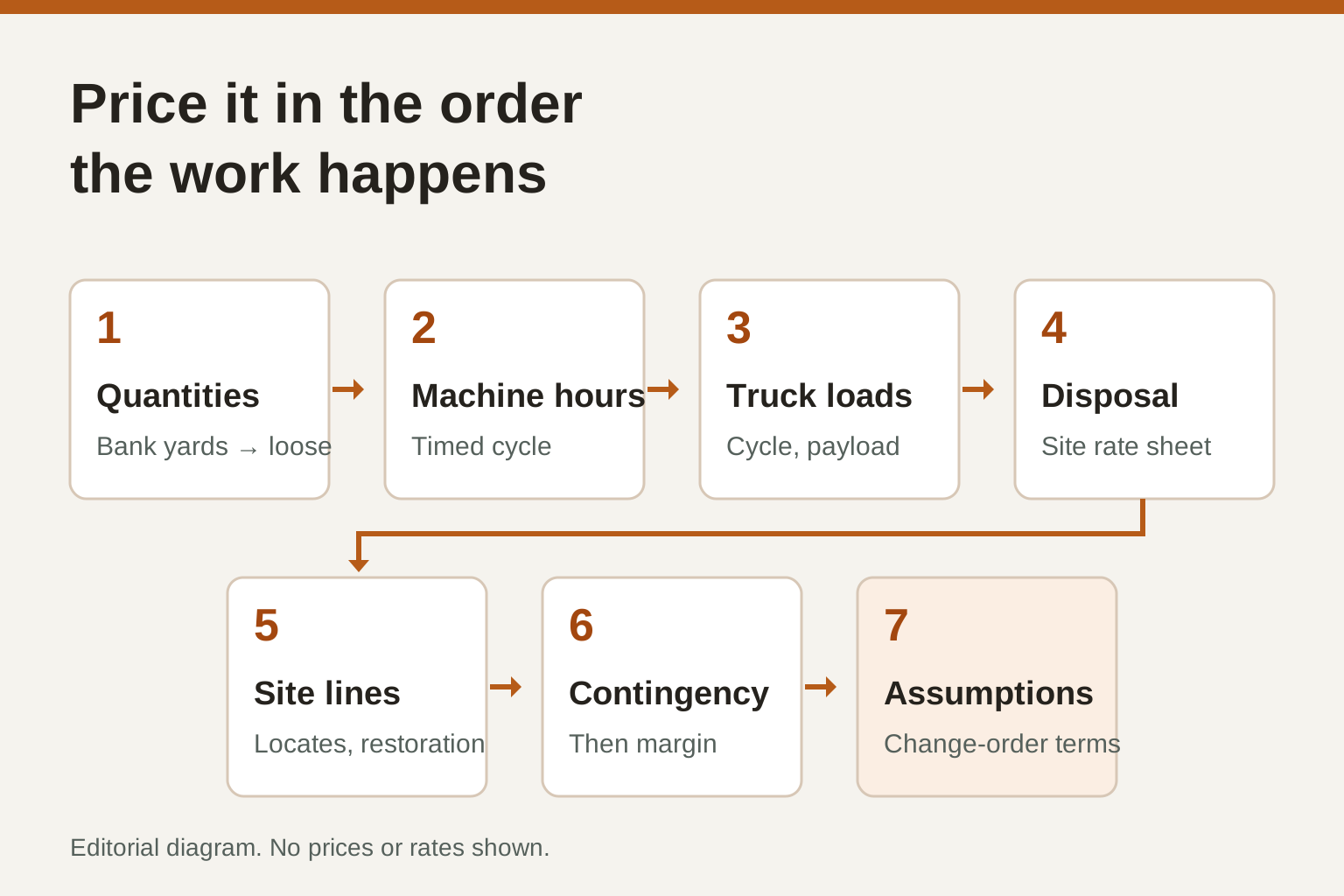
To price an excavation job, estimate it in the order the work happens. Measure the cut in bank cubic yards, convert it to loose yards for hauling, turn that volume into machine hours with a production rate, work out how many truck loads and truck hours the spoil needs, then price disposal from the receiving site's own rate sheet. Add mobilization, restoration, locates and permits as separate lines, put a contingency against named risks, and only then apply your margin. Write down the assumptions behind each quantity so a change order has something to point to.
01
Price the job in the order the work happens
A quote built from one blended number, such as a price per hour or a price per yard pulled from memory, hides the lines that actually move on small jobs: how much the soil swells, how long the truck is away, and what the dump site charges. Building the price in the same order as the work keeps each of those visible.
A practical sequence is: quantities, production, trucking, disposal, the site-specific lines (mobilization, restoration, locates, permits), contingency, then margin. Each step feeds the next. You cannot count truck loads until you know the loose volume, and you cannot set machine hours on a haul-off job until you know how long each truck is gone.
This guide covers that estimating sequence. Choosing an hourly rate, a day rate or a minimum charge is a different decision, covered in the mini excavator pricing guide. How much the business as a whole must bring in per billable day belongs to the small excavation business guide. Here, the goal is a line-item estimate you can defend to a customer.
02
Step 1: Measure the cut in bank cubic yards, then convert it
Start from the dimensions you measure on the site visit: length, width and average depth of every cut. Multiply them in feet and divide by 27 to get cubic yards. That figure is bank volume, the soil as it sits in the ground before you disturb it.
The U.S. Army's earthmoving field manual, FM 5-434 Chapter 1, uses three states for the same soil: bank cubic yards (BCY) in place, loose cubic yards (LCY) after digging, and compacted cubic yards (CCY) after compaction. The numbers differ because digging creates voids. Its average conversion table lists, for bank soil converted to loose soil, 1.25 for loam (common earth), 1.43 for clay and 1.11 for sand or gravel. Bank loam converted to compacted is 0.90.
Those factors decide three different lines in the estimate:
- Digging is measured in bank yards, because that is what the bucket removes from the ground.
- Hauling and disposal are measured in loose yards (or tons), because that is what fills the truck bed.
- Backfill is measured in compacted yards. For loam, the same table gives 0.72 from loose to compacted, so every compacted yard of backfill takes about 1.39 loose yards of spoil (1 ÷ 0.72).
The manual is explicit that these are averages for common materials and that weights and factors vary with grain size, moisture and compaction. Treat the table as a starting point, note the soil type you assumed in the quote, and adjust it once you have your own records from similar ground.

03
Step 2: Turn bank yards into machine hours
FM 5-434's hydraulic excavator chapter calculates production from four inputs: bucket size, bucket fill factor, cycle time and working efficiency. Its formula is:
Loose yards per hour = 3,600 ÷ cycle time in seconds × bucket size in cubic yards × fill factor, then adjusted for a working hour of less than 60 productive minutes (the manual's worked example uses 50), then converted to bank yards.
The manual's average cycle for small hoes (buckets under 1 cubic yard) is 14 seconds, but only under what it calls average conditions: a cut between 40 and 60 percent of the machine's maximum digging depth and a swing of 30 to 60 degrees. Deeper cuts and wider swings take longer. Its fill factors range from 100–110 percent for moist loam or sandy clay down to 80–90 percent for hard, tough clay.
Its own advice is to use a cycle time from past performance when you have one. For a small contractor, that is the most useful habit to build. Time 20 cycles with a phone stopwatch on your own machine in the kind of ground you usually dig, and record the soil and the depth. A tight backyard, a trench beside a foundation or loading over a truck's side will not match the manual's average.
Width, depth, material, digging and dumping radius, and the height you have to dump to all affect production, according to the same chapter. On many small jobs, though, the digging rate is not what sets the hours on site. The truck usually is.
04
Step 3: Let the truck cycle set site time on haul-off jobs
A truck cycle is the time for a loaded truck to drive to the dump site, unload, come back and be loaded again. FM 5-434's hauling chapter estimates how many trucks are needed to keep the loading machine busy as 1 plus the truck cycle time divided by the loading time per truck. It also warns that too few trucks costs production, because the loader waits.
For a small contractor with one truck, that waiting is the estimate. Say the dump site is 25 minutes away: the excavator may load a truck in 15 minutes and then stand for most of an hour. The machine hours you quote have to cover that time, or the haul-off plan has to change: a second truck, a subcontracted hauler, or stockpiling the spoil and loading everything in one visit.
Count loads by weight as well as volume. Using a scraper as its example, the same manual explains that a light material fills the body before reaching the weight limit, while a heavy one reaches the weight limit first. The same logic applies to a dump truck. The manual's weight table puts dry loam at roughly 1,900–2,200 pounds per loose cubic yard and wet loam at roughly 2,800–3,200. Wet soil can therefore hit a truck's legal payload well before the bed is heaped.
The payload that matters is the one your truck is registered and rated to carry on the roads you will use. The Federal Highway Administration lists 80,000 pounds gross vehicle weight, 20,000 pounds per single axle and 34,000 pounds per tandem axle as the federal maxima on the Interstate System, and notes that states set their own weight standards off the Interstate. Divide your legal payload by the heavier soil weight to get a safe load size, then divide the loose volume by that load size and round up.

05
Step 4: Price disposal from the receiving site's rate sheet
Disposal is the line most likely to be off by a multiple rather than a percentage, because the receiving site decides how it charges. Two public landfill schedules published for 2026 show the range of structures:
- Larimer County, Colorado lists clean dirt at $100 per load for a tandem and $180 per load for a side or end dump (including the Colorado surcharge), and concrete or asphalt rubble at $40 per cubic yard plus surcharge.
- Howard County, Maryland (Alpha Ridge Landfill, schedule effective July 1, 2026) lists clean dirt at $132 per ton, notes that the charge may be waived or the volume limited and asks haulers to call first to confirm clean soil is being accepted, and lists construction and demolition debris and broken paving at $106 per ton.
These are two examples, not typical prices. The point for your estimate is structural: one site charges by the load, another by the ton, and acceptance of clean soil can change. Before you price disposal, call the site you will actually use and write down its current rate, its unit (load, ton or cubic yard), whether it accepts the material you expect, and whether mixed debris, stumps or concrete are priced differently. Put that facility name and rate in your assumptions.
06
Step 5: Add the lines that are easy to leave out
Mobilization. Loading, hauling the machine, unloading and returning are real costs even on a two-hour job. Use whichever method you already apply consistently; the mini excavator pricing guide linked above compares zone fees, portal-to-portal time and minimums.
Locates and private lines. OSHA's excavation standard, 29 CFR 1926.651, requires the estimated location of underground utilities to be determined before an excavation is opened, and utility owners to be contacted within established or customary local response times and asked to mark their lines before digging starts. It also requires the exact location to be determined by safe and acceptable means as the work approaches those lines. The Common Ground Alliance's 811 site describes 811 as the free national before-you-dig service and says to contact 811 a few business days before digging. Build that lead time into the schedule, and allow hours for slower, careful work near marked lines. 811 does not cover everything: Colorado 811, for example, states that private utilities are not part of an 811 locate request and must be located at the owner's expense by a private locating company, listing lines such as gas lines to backyard grills, septic systems and sprinkler systems. Decide in writing whether a private locate is in your price or is the owner's responsibility.
Restoration. Price restoration from quantities, not a lump guess: backfill in compacted yards (converted back to loose spoil as in Step 1), plus any imported material, topsoil depth over the disturbed area, and seed or sod by area. If the quote says "restore," define to what: rough grade, topsoil and seed, or a finished surface.
Permits. Ask the local permitting office whether the work needs a permit and how long approval takes. If it does, carry the fee and the waiting time as their own lines rather than folding them into the machine rate.
07
Step 6: Add contingency for named risks, then margin
Contingency is easiest to defend when it is attached to a specific risk you saw on the site visit: a hint of rock in the neighboring cut, a wet low corner, an old foundation line, a long walk for the truck. Price each one as an allowance or a unit rate you can explain. A single unexplained percentage is hard to defend and easy to cut.
Margin comes last. DirectExcavator's Excavation Estimate & Quote Calculator uses (direct cost + overhead + contingency) ÷ (1 − target margin), and notes that a 20% margin is not the same as a 20% markup. Enter your quantities, hours and disposal lines there to get the quote total rather than adding a markup percentage in your head.
08
Step 7: Write the assumptions that trigger a change order
Every quantity in the estimate rests on something you assumed: the soil type behind the swell factor, the depth you measured, no rock, no standing water, the dump site and its rate, utilities marked before the start date. List those assumptions on the quote. They define what "changed conditions" means for this job.
Federal construction contracts handle this with a standard clause. FAR 52.236-2 (Differing Site Conditions) requires the contractor to give written notice promptly, and before the conditions are disturbed, of subsurface or latent conditions that differ materially from those indicated in the contract, or of unusual unknown conditions that differ materially from those ordinarily encountered. If the conditions do differ and change cost or time, the clause provides for an equitable adjustment and a written contract modification.
A private residential quote is not a federal contract, and your own contract terms and state law govern it. The clause is still a useful model: say what you assumed, say that you will stop and notify the customer in writing before continuing through something different, and state the rates that apply to the extra work. That matches the calculator's own change-order guidance: set hourly equipment and labor rates for extra work, require written approval, and document quantity changes before continuing.
09
A worked example: 30 × 20 ft pad, 18 inches deep, all spoil hauled off
The example below is hypothetical. The dimensions, bucket size, cycle time, truck payload and haul time are assumptions chosen to show the arithmetic, not benchmarks. The conversion factors and soil weights come from FM 5-434's averages, and the disposal rates are the two published 2026 schedules above.
| Line | Input | Arithmetic | Result |
|---|---|---|---|
| Bank volume | 30 × 20 × 1.5 ft | 900 ft³ ÷ 27 | 33.3 BCY |
| Loose volume | Loam, bank-to-loose 1.25 | 33.3 × 1.25 | 41.7 LCY |
| Spoil weight | Dry loam 1,900–2,200 lb/LCY | 41.7 × 1,900 to 2,200 | 39.6–45.9 tons |
| Loads, dry | 24,000 lb payload | 24,000 ÷ 2,200 = 10.9 | 10 LCY a load, 5 loads |
| Loads, wet | Wet loam 3,200 lb/LCY | 24,000 ÷ 3,200 = 7.5 | 6 loads |
| Excavator output | 0.25 cy, 20 s, 100% fill | 3,600 ÷ 20 × 0.25 × 50/60 | 37.5 LCY/h |
| Loading per truck | 10 LCY | 10 ÷ 37.5 × 60 | 16 min |
| Truck cycle | 60 min away | 60 + 16 | 76 min |
| One truck | Starts 0, 76 … 304 | 304 + 16 | 320 min (5.3 h) |
| Two trucks | Starts 0, 16, 76, 92, 152 | 152 + 16 | 168 min (2.8 h) |
| Disposal per load | Larimer: $100 a tandem | 5 × $100 | $500 |
| Disposal per ton | Howard: $132/ton, if accepted | 39.6–45.9 × $132 | $5,230–$6,060 |
The assumed payload is 24,000 pounds, the measured cycle is 20 seconds with a 0.25 cubic yard bucket, the working hour is 50 minutes, and the truck is away 60 minutes to reach the dump site, unload and return. With two trucks, the second truck is loaded straight after the first, so loads start at 0, 16, 76, 92 and 152 minutes.
Three things stand out. Digging 41.7 loose yards at 37.5 per hour takes a little over an hour, yet one truck keeps the excavator on site for more than five. A second truck cuts the excavator time roughly in half while the total truck driving time stays about the same, so the decision is a pricing decision, not just a scheduling one. And the disposal line swings by more than ten times depending on which site takes the soil and how it charges.
None of those numbers is a price for your job. Replace every input with your own site measurements, your machine's timed cycle, your truck's legal payload, your real haul time and the rate sheet from the site you will use. Then add mobilization, restoration, locates, permits and contingency, and run the total through the calculator for margin.
10
Sources and limitations
Prepared by the DirectExcavator editorial team from public government, industry and county sources. Conversion factors and weights are FM 5-434 averages for common materials; the two county fee schedules are dated 2026 examples, not typical prices; FAR 52.236-2 is a federal contract clause used as a model, not legal advice. The worked example is hypothetical and is not a customer job or a price.
Run your line items through the calculator
Once you have quantities, machine hours, truck loads, a disposal rate and your site-specific lines, open the Excavation Estimate & Quote Calculator to add overhead, contingency and margin and produce a customer quote. Keep the assumptions list from Step 7 with it. The calculator is a planning tool: your own costs, local rates and contract terms still decide the final price.