
The short answer
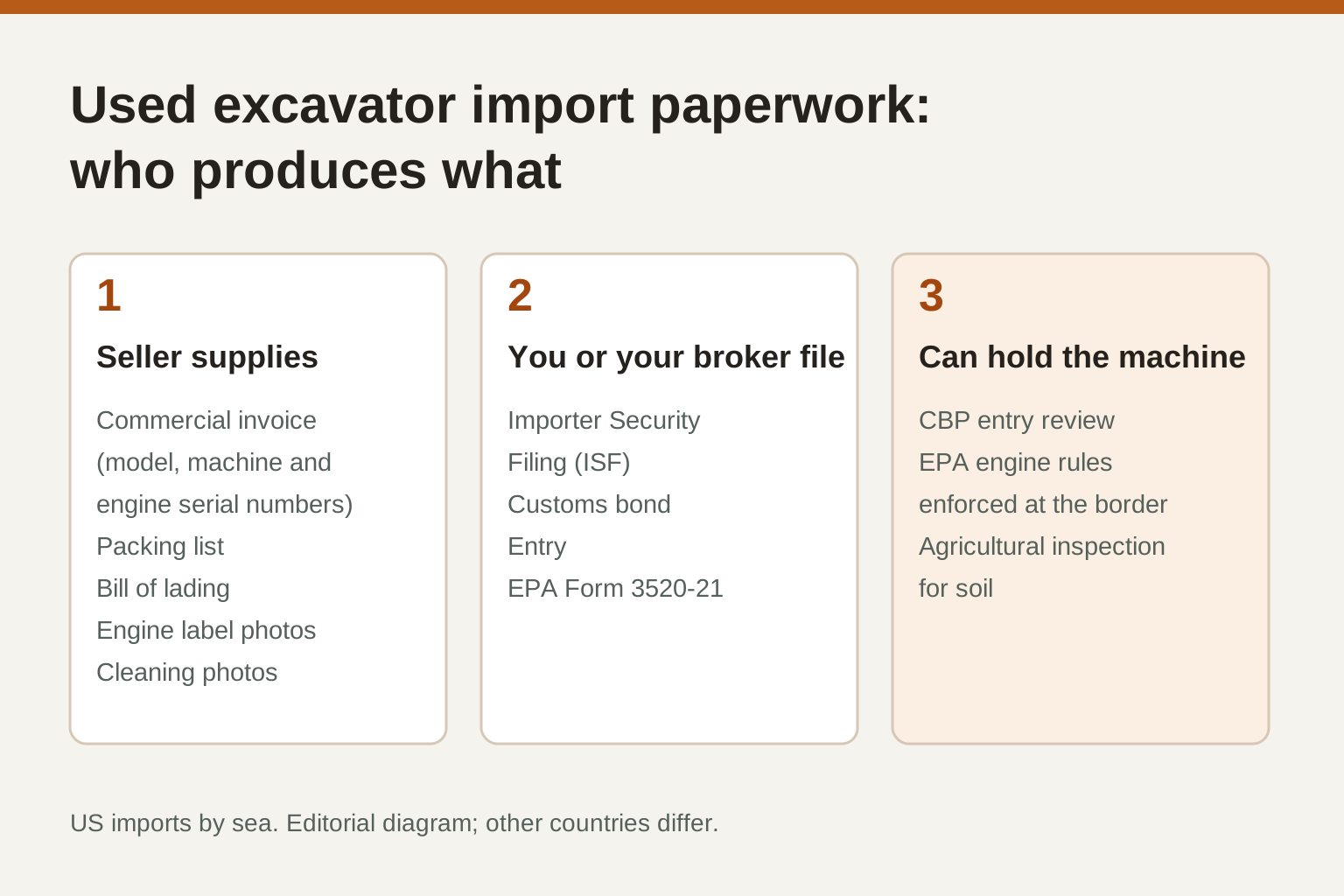
For a used excavator shipped by sea into the United States, the paperwork falls into three groups. The seller supplies a commercial invoice that describes the exact machine, a packing list and the bill of lading, plus evidence about the engine's emission label and the machine's cleanliness. You, or the licensed customs broker acting for you, file the Importer Security Filing before the machine is loaded, the entry and a customs bond, and EPA Form 3520-21 for the engine. CBP, and the agencies it enforces for, can hold the machine if any of that is missing or inconsistent. Other countries have different rules, so confirm the list with your local customs authority or a licensed broker before you pay.
01
Sort the paperwork by who has to produce it
Most document lists online are one long column: invoice, packing list, bill of lading, certificate of origin and so on. That hides the question that actually decides whether you get stuck: who is responsible for each paper, and when it has to exist.
Split it three ways. The seller controls the documents that describe the machine and the sale: the commercial invoice, the packing list, the bill of lading issued by the carrier, and the machine and engine identification you will need later. The importer of record controls the filings made to U.S. Customs and Border Protection (CBP): the Importer Security Filing, the entry, the bond and the EPA engine declaration. Then there are the checks you do not file at all but can still be stopped by: CBP's review of the entry, the EPA emission rules it enforces at the border, and agricultural inspection for soil.
Who can make the entry matters too. CBP's guide for commercial importers states that goods may only be entered by their owner, purchaser, or a licensed customs broker, and that licensed brokers are the only agents authorized to transact customs business for importers. If you are not set up to file entries yourself, a licensed broker files them for you. This checklist is written so you can hand the seller's half to the seller and the filing half to your broker.

02
Commercial invoice: it has to describe this machine, not "one used excavator"
A short pro forma with a model name and a price is not enough. U.S. rules ask for more. Under 19 CFR 141.86, each invoice must show, among other things:
- the port of entry the goods are going to;
- when, where, by whom and to whom the goods were sold;
- a detailed description, including the name the item is known by, its grade or quality, and the marks, numbers and symbols under which it is sold, plus the marks and numbers of the packages;
- the quantities;
- the purchase price of each item in the currency of the purchase;
- all charges itemized by name and amount, including freight, insurance, commission and packing, where they apply;
- the country of origin.
The same section requires the invoice and its attachments to be in English or to carry an accurate English translation, and says the invoice must state in adequate detail what is in each individual package.
For a used excavator, the most useful way to meet that description requirement is to list the identifiers that tie the paper to the steel: make, model, machine serial number, engine make, model and serial number, and year of manufacture. Put them on the invoice, and make sure they match the serial plate photos from your inspection. If the bucket, boom or counterweight travels as a separate package, the invoice and packing list should say so.
03
Packing list and bill of lading: what CBP uses to release the cargo
CBP's list of entry documents in 19 CFR 142.3 includes a packing list "where appropriate". A machine shipped with detached parts, a spare bucket or crated attachments is exactly the case where you want one: each package, its contents, its marks, and its weight and dimensions, consistent with the invoice.
The bill of lading does a different job. Under 19 CFR 141.11, a bill of lading presented by its holder, properly endorsed when endorsement is required, is one form of evidence that you have the right to make entry. The regulation also allows a carrier's certificate or a certified duplicate instead. Before the machine sails, check that the consignee and notify party on the bill of lading are the people your broker expects, and agree with the seller how and when the original or a release will reach you.
04
What your broker files: ISF, entry and bond
Importer Security Filing (ISF). For cargo arriving by vessel, 19 CFR 149.2 requires the ISF importer or an authorized agent to transmit the filing electronically. Eight elements are due no later than 24 hours before the cargo is laden aboard the vessel at the foreign port: the seller, the buyer, the importer of record number, the consignee number, the manufacturer or supplier, the ship-to party, the country of origin and the commodity's tariff (HTSUS) number. The container stuffing location and consolidator follow no later than 24 hours before arrival in a U.S. port. The ISF importer must also have a bond that covers the filing (19 CFR 149.5). The practical consequence: your broker needs the seller's details and the machine's classification before the loading date, not after.
Entry. The entry documents listed in 19 CFR 142.3 are the release form (CBP Form 3461 or its electronic equivalent), evidence of the right to make entry, the commercial invoice, a packing list where appropriate, and any other documents CBP or another agency requires for that shipment. Under 19 CFR 142.2, entry is due within 15 calendar days after the goods land, and the documents may be submitted before arrival.
Bond. Under 19 CFR 142.4, merchandise is not released from customs custody unless a single-entry or continuous bond on CBP Form 301 has been filed (cash or U.S. government obligations can secure it instead). CBP's importer guide notes that a broker making the entry may let you use the broker's bond; either way, confirm which bond will cover your entry before the ship arrives.

05
The engine: EPA Form 3520-21 and the emission label
This is the document that decides whether some used excavators can enter at all. EPA's Form 3520-21 must be submitted to CBP by the importer for each imported nonroad engine, including engines already installed in equipment. The form must be kept for five years from the date of entry. An excavator's diesel engine falls in the form's category for other nonroad compression-ignition engines.
The general rule in 40 CFR 1068.301 is that imported engines and equipment must be covered by an EPA certificate of conformity unless they were built before emission standards started to apply. The same section says CBP may prevent the import if those requirements are not met, that the EPA declaration must be completed before importing, and that uncertified engines or equipment may be treated as "new" on importation even if they have already been used.
On the form, the import basis is chosen by code. The ones a used-machine buyer most often reads about are:
- Code 1: a U.S.-certified engine covered by a valid certificate of conformity and bearing an EPA emission control label in English.
- Code 8, identical configuration: the engine must be identical in all material respects to a U.S.-certified version, the importer must have owned it for at least six months before importation, and an EPA letter of approval must be attached.
- Code 17: engines manufactured before emission standards started to apply. The schedule on the form places those start dates for nonroad diesel engines between January 1, 1996 and January 1, 2000, depending on engine power.
The form also lists the penalties: illegally importing an engine can bring a fine of up to $55,808 per engine, forfeiture of an importation bond where one applies, and seizure.
What to do with that before you pay: ask the seller for a clear photo of the engine's emission label and the engine serial plate, and send both to your broker. If there is no EPA emission control label, the code 1 description on the form does not fit that engine. Whether any other code fits is a question for EPA and your broker; do not rely on a seller's statement that it "passes EPA".
06
Clean machine: soil is a regulated import on its own
A used excavator arrives with a bucket, tracks and undercarriage that have been in the ground. U.S. plant-pest rules treat soil as a regulated article in its own right. Under 7 CFR 330.203, soil that has not been sterilized needs an import permit, and 7 CFR 330.105 makes any article an inspector believes may carry a plant pest subject to inspection at the first port of arrival, with no release until the inspector releases it.
For a machine, the practical answer is not a permit but a clean machine: it should leave the seller's yard without soil on it. Ask for cleaning to cover the bucket, tracks, rollers and undercarriage frame, and for dated photos of those areas after cleaning and before loading. Keep them with the rest of your file; they are your evidence if the machine is held for inspection.
07
Certificate of origin and inspection reports: useful, but not the same thing
Two papers show up on almost every exporter's list and cause confusion.
A certificate of origin is not on the list of entry documents in 19 CFR 142.3. For a U.S. entry, the country of origin already has to appear on the commercial invoice (19 CFR 141.86) and in the ISF (19 CFR 149.2). A separate certificate may still be requested for a particular shipment, since 142.3 allows other documents required by CBP or other agencies, and other countries' rules may require one. Ask your broker whether your entry needs it rather than paying for it by default.
A pre-shipment inspection or condition report is not a U.S. customs document at all. It is your evidence as a buyer: proof that the serial numbers on the invoice belong to the machine you inspected and that its condition matches the price. Treat it as the check you complete before money moves, using a used excavator inspection evidence review, not as something that clears customs.
08
The checklist to send your seller and your broker
| Document or step | Who provides it | When | Basis |
|---|---|---|---|
| Commercial invoice | Seller | Draft before payment | 19 CFR 141.86 |
| Packing list | Seller | Before loading | 19 CFR 141.86(e), 142.3 |
| Bill of lading | Carrier, via seller | At loading | 19 CFR 141.11 |
| Engine label and serial photos | Seller | Before payment | 40 CFR 1068.301 |
| Cleaning photos | Seller | Before loading | 7 CFR 330.203, 330.105 |
| Importer Security Filing | Importer or broker | 24 h before loading | 19 CFR 149.2 |
| Customs bond | Importer or broker | Before release | 19 CFR 142.4 |
| Entry | Importer or broker | Within 15 days of landing | 19 CFR 142.2, 142.3 |
| EPA Form 3520-21 | Importer or broker | With entry; keep 5 years | EPA Form 3520-21 |
| Certificate of origin | Seller, if required | Ask your broker | Not on the 142.3 list |
| Inspection report | Your inspector | Before payment | Buyer evidence only |
The invoice line means the full content listed above: model, machine and engine serial numbers, price, itemized charges and country of origin, in English. The ISF line means all the elements your broker asks for, which is why the seller's details have to reach the broker before the loading date.
This article does not cover import duties, taxes or payment methods. For the cost side, use the landed cost estimator. For the full buying sequence, from machine proof to freight, see how to import used machinery from China.
09
Sources and limitations
Prepared by the DirectExcavator editorial team from U.S. federal regulations (eCFR point-in-time text as of September 1, 2026), EPA's import declaration form and a CBP importer guide, retrieved September 25, 2026. General information only: not legal or customs advice, and not a complete list for every shipment or country. Duty rates, taxes and payment methods are not covered.
Match the paperwork to the exact unit before you pay
When you have a specific machine in view, send the machine type, year band, hours and destination port and ask for the serial-plate, engine-label and current condition proof for that unit. Compare what comes back with the checklist above, then give the filing half to your customs broker. This article is general information about U.S. federal rules as retrieved on September 25, 2026. It is not legal or customs advice, and it does not replace a licensed customs broker or the customs authority of your country.