
The short answer
If an excavator is stuck in a ditch, stop improvising a recovery sequence. Notify the person responsible for site safety and obtain the exact machine instructions and a site-specific assessment before another attempt. A video, a running engine or apparently firm ground does not establish permission to move the machine. If anyone is injured, trapped or in immediate danger, contact local emergency services; this guide is not an emergency rescue procedure. Use this article to decide whether to stop, to describe the incident for qualified help, and to organise inspection questions afterward. It does not select a bearing point, pull direction, rigging capacity or escape movement; recovering a stuck or buried machine is a qualified task, and evacuation, shutdown, stabilisation and movement decisions belong to responsible on-site personnel using the actual machine instructions and conditions.
01
Stop movement and protect the area
The first task is to alert the person responsible for site safety, not to “drive harder.” Do not enter the ditch or approach the machine merely to investigate for this article. Access, emergency action and any shutdown procedure must be determined from the actual hazards and machine instructions, not from a generic checklist.
Record observations already available from a safe location: track position, machine lean, visible soil changes, water, alarms or damage. Do not approach an unsupported machine to obtain better photographs or test a component. Describe what is visible without converting an image into a diagnosis or a claim that the machine remains fit to move.
Treat the ditch as an excavation hazard, not simply a low spot. For covered U.S. construction work, OSHA 1926.651 addresses underground installations and water accumulation, and it requires a competent person to inspect the excavation and adjacent area and to remove exposed employees when a hazard is identified. Trade-press slope-safety guidance also notes that on a grade the margin against roll, slide or pitch shrinks with every degree, and that a leaning machine over soft, saturated ground can pass its tipping point quickly. Those points frame the hazard; they are not a machine-recovery method or a determination of this bank's capacity. The responsible team must establish the applicable local requirements and actual site conditions.
02
Stop, or hand the recovery to qualified help
Working controls do not establish permission to attempt self-recovery. Use the table below to decide whether to stop and call for qualified help; it is not a stop/go test, a machine-stability assessment or an approved recovery procedure. If any row points to stopping, stop.
“It worked in a video” is not an acceptance criterion. The model, mass, attachment, reach, ground, ditch geometry and operator skill may all be different. A safe decision needs current site evidence and the exact machine instructions.
| Observed condition | What it suggests | Decision |
|---|---|---|
| Machine appears stationary and the ditch edge shows no visible movement | Appearance alone does not establish ground capacity or a permissible movement | Obtain the exact machine instructions and a qualified site assessment; this observation does not authorise a trial movement |
| A track spins or the machine settles after an attempted movement | Spinning a track digs the machine deeper and can undercut the bank; available support is decreasing | Stop. Report the observation; do not perform another trial to diagnose it |
| Machine lean or position has visibly changed, or the cab or counterweight is moving toward a rollover line | No safe angle or stability margin has been established and the margin may be disappearing | Stop, secure the area and obtain a qualified recovery plan; follow the site's emergency procedures |
| Bank cracks, sloughs or contains moving water; utilities or voids are unknown | The support surface cannot be treated as reliable | Stop and have a competent person evaluate the excavation and recovery zone |
| Track, final drive, blade, boom, bucket, coupler or hydraulics may be damaged | This guide cannot establish equipment condition or permitted loads | Stop. Report the concern to qualified equipment personnel; no stabilisation or inspection procedure is supplied here |
| The machine is buried to the frame or belly pan, or a safe exit would need a sideways pull, shock loading or people close to the machine | This is a qualified recovery job, not a self-recovery one | Use a qualified recovery specialist with correctly rated equipment; this row does not select a method |
This is a stop-or-escalate screen, not authorisation to move the machine or a substitute for the operator manual and a qualified recovery plan.
03
What the field demonstration actually shows
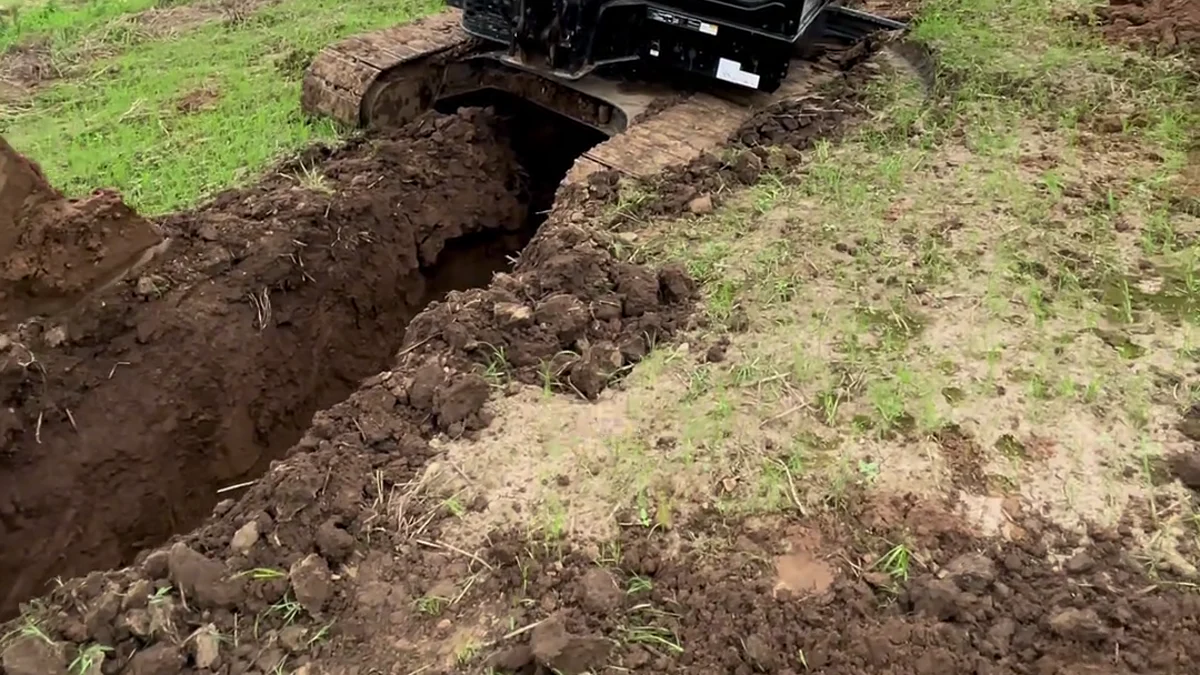
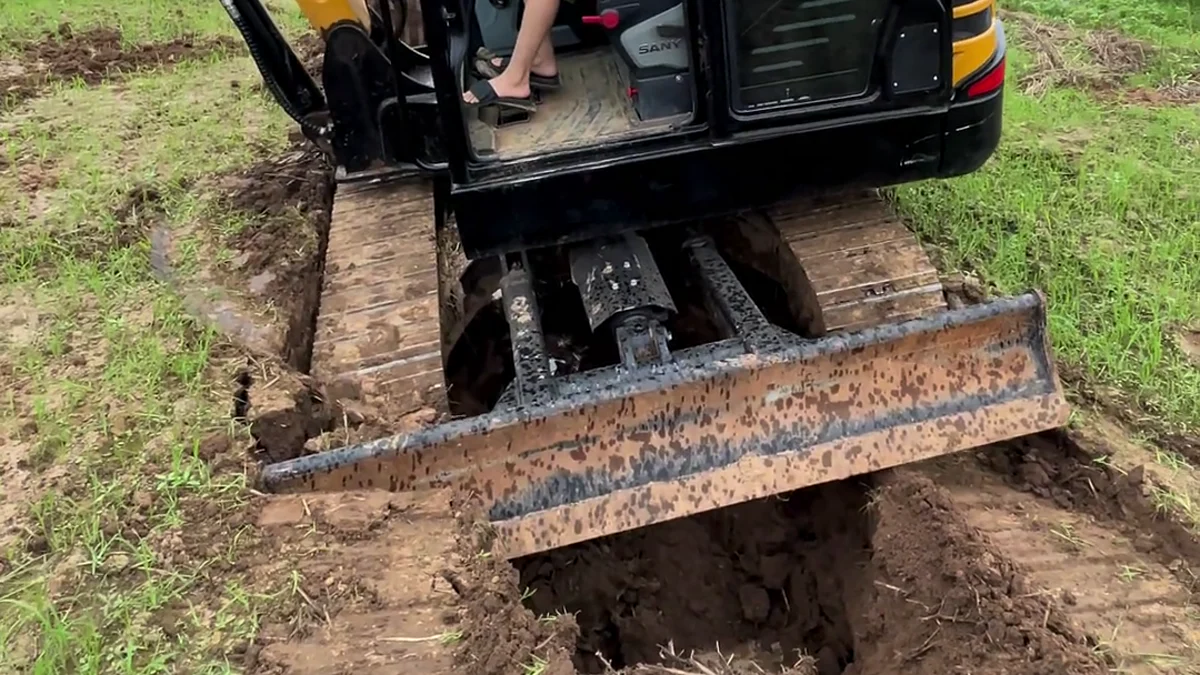
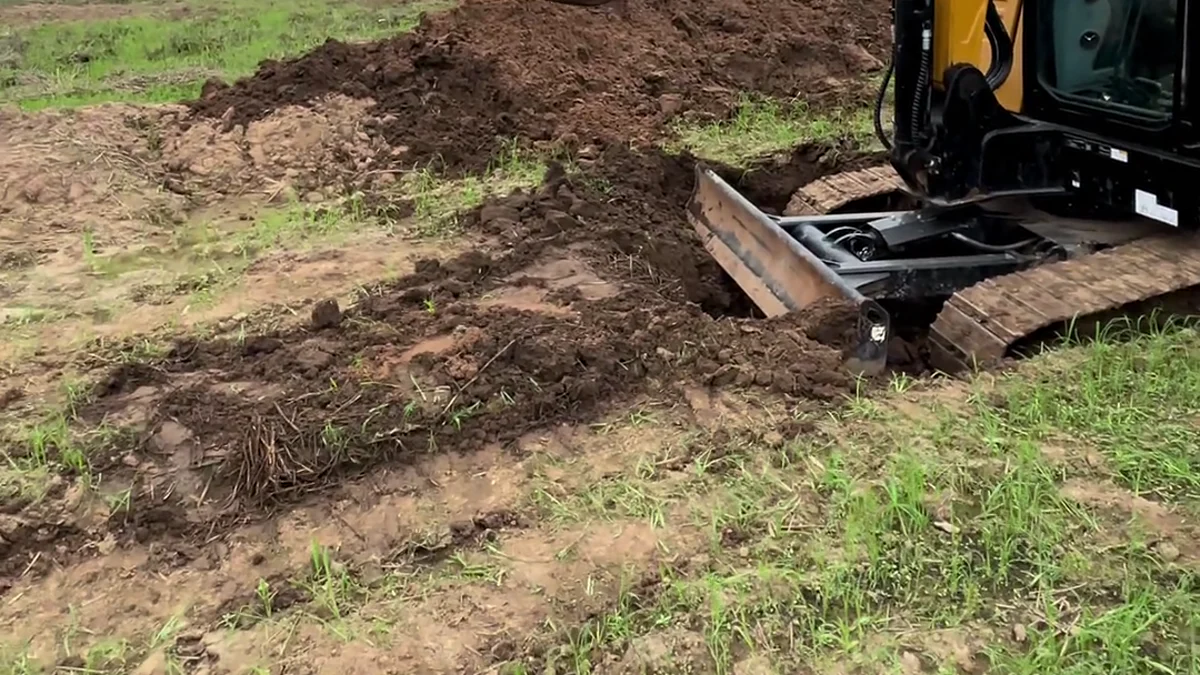
The field clip shows a compact excavator straddling a narrow muddy ditch with the machine leaning and part of the undercarriage over the ditch. The operator first rotates the upper structure and repositions the front attachment while a person outside the machine gives directions. The blade and tracks are then realigned relative to the ditch. In the final sequence, the bucket contacts the ground and the machine moves forward while the arm is adjusted; the tracks move beyond the visible ditch edge. The footage does not measure the support conditions or establish why that movement succeeded.
The movement is an observation, not evidence of a safe support point or an approved use of the attachment. This clip cannot establish the machine's permitted loading, stability or recovery limits, and this article does not derive a bucket-push, blade-lift or combined travel-and-arm procedure from it. Assess what you can see and what you cannot; do not treat the clip as a method to copy.
The clip also leaves important questions unanswered. It does not establish ditch depth, soil capacity, buried services, machine weight, rated limits, undercarriage condition, hydraulic settings, exclusion-zone control or a backup plan. Use the images as a field illustration of the problem, not as proof that the same sequence is safe elsewhere.
04
Why a stuck excavator is a qualified-recovery job
Recovering a stuck or buried machine is a qualified task, not a bigger version of normal operating. Recovery-training and rigging guidance is consistent on the basics: use a rated line, strap or chain connected to the machine's manufacturer-designated recovery or tie-down points; pull smoothly with no running start and no jerk or shock load; and size the equipment well above the machine's operating weight, because a stuck machine can need several times its own weight in pull force. Rigging a load of this size is itself a certified discipline, and a general article cannot establish the recovery points, capacities, angles or communication plan for your machine.
An operator manual's Towing section is not a substitute for that plan. Towing procedures cover relocating a disabled machine a short distance, at a restricted speed, with a rigid tow bar or rated equipment, after the travel motors or brakes are released as the manual specifies. That is not a bucket-assisted or blade-assisted self-recovery procedure, and towing a machine that is still bogged, leaning or buried is outside its scope. Your exact machine's manual governs both.
If the machine has rolled or is badly buried, the job needs a plan and rated rigging from people who do this work: recovery specialists upright and extract overturned or sunk excavators with wreckers, rotators, cranes and rated winches, then inspect before moving the machine again. Calling qualified help early is cheaper and safer than a second failed attempt that undercuts the bank, damages the undercarriage or puts people in the line of a pull.
05
Know the stop signals
Whether the site is waiting for a recovery contractor or a competent person is still assessing the excavation, stop any movement and give the responsible team an accurate account if any of the following happens:
- the lean angle increases or the cab or counterweight moves toward a rollover path;
- the ditch wall cracks, sloughs, caves or releases water;
- a track spins without controlled travel, drops farther or begins to derail;
- the bucket, blade or any chosen bearing point slips or sinks;
- the machine contacts the bank, counterweight or undercarriage in an unplanned way;
- a hose leaks, an alarm appears or a structural or undercarriage defect becomes visible;
- anyone enters the exclusion zone or the line of a pull;
- the next move would exceed the manual, require shock loading or depend on uncertain rigging.
Do not omit an uncertainty because it seems inconvenient, and do not convert “nothing looks wrong” into a stability or rigging decision. The responsible site and equipment personnel determine the controls and assistance required; this article does not specify a stabilisation method.
06
Inspect the excavator after it reaches firm ground
Reaching level ground is not an inspection result. Recovery specialists inspect a machine before moving it again, and you should too. Ask qualified service personnel which checks the exact machine instructions require after the incident and who owns the return-to-service decision. This guide does not instruct anyone to park, lower an attachment or inspect an unsupported machine.
Give service personnel the recovery record, photographs already obtained safely, alarms and any reported leakage or damage. Use the used-excavator inspection checklist to organise condition questions across the undercarriage, final drives, blade, boom, bucket, coupler, hoses, cylinders and structure, not as a model-specific repair procedure. For U.S. construction work, OSHA's general safety provisions require frequent and regular inspections by a competent person and state that equipment which does not meet applicable safety requirements must not be used until it is made to comply; they do not supply excavator recovery or repair criteria.
Record known facts separately from suspected causes so the responsible team can investigate. If you are assessing a machine for purchase, discuss the inspection evidence with Direct Excavator. That is an equipment-condition inquiry, not emergency assistance, a recovery-service promise or permission to operate the machine.
08
Sources
User-supplied clip: observational illustration only; no model-specific recovery procedure supplied.