The short answer
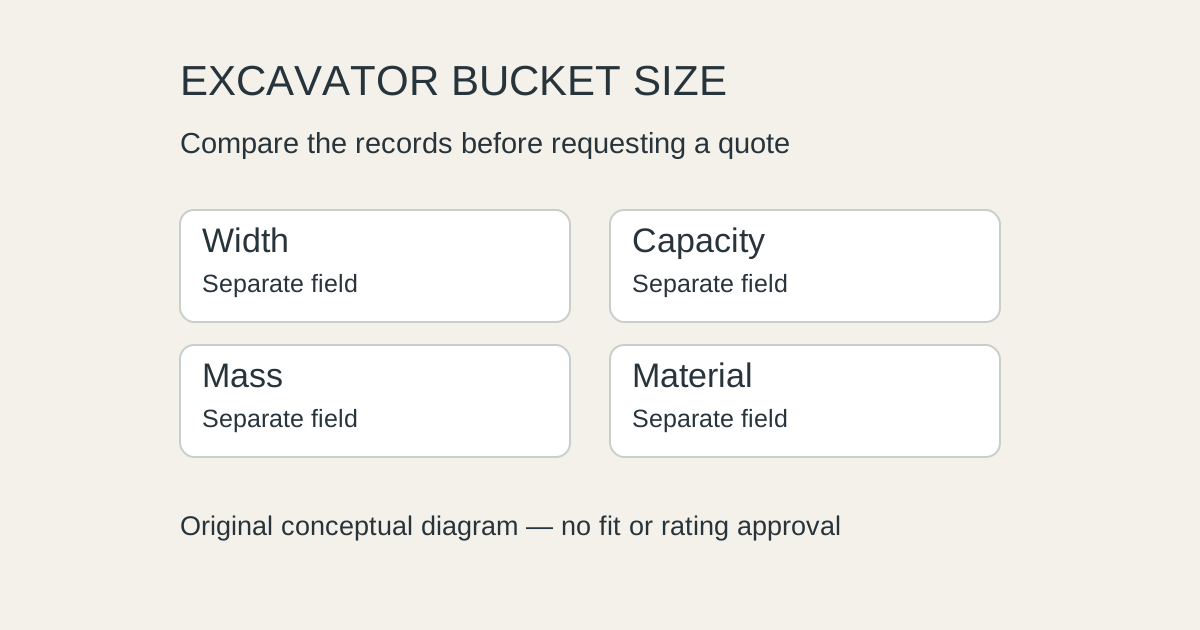
Choose an excavator bucket size by separating its width, declared capacity and empty weight, then matching those records to the material, required cut and actual excavator configuration. A width label does not tell you how much material the bucket holds, and a volume figure does not tell you the loaded mass. Before accepting a bucket in a used-machine offer, request its identification, capacity basis, weight and carrier-specific matching documents. Keep missing fields visible rather than filling them from a generic machine-tonnage chart.
01
Quick answer
Read an offer in this order:
- Identify the exact bucket and write width, capacity and empty weight in separate fields.
- Confirm whether the capacity is struck or heaped and which rating basis the supplier uses.
- Describe the material and distinguish actual retained volume from the published capacity.
- Include the bucket, coupler and other fitted attachment weights in the machine-specific discussion.
- Compare the cut requirement and complete documentation before comparing prices.
The result is a clearer purchase requirement. The machine-specific matching decision still needs the applicable manufacturer information.
02
Separate width, rated capacity and empty weight
Start with three separate entries: width, rated capacity and empty attachment weight. Width describes one dimension of the working tool. Capacity declares a volume. Weight describes the empty bucket or other identified attachment. They answer different questions, so an offer that supplies only a width leaves two important parts of the comparison unresolved.
The Foley Equipment bucket listing presents width, capacity and weight as separate specification fields. Its related products also show that buckets with the same nominal width can carry different capacity and weight declarations. That is a useful reason to request an exact product reference rather than treating every bucket with the same width as equivalent. The catalogue does not verify the bucket supplied with your machine.
Ask for a bucket identification plate, product reference or manufacturer document that the seller can connect to the offered attachment. Record the units exactly as supplied. Do not silently change a cubic-foot entry into cubic yards, or compare inches with millimetres without a clear conversion. If a quoted weight includes teeth, side cutters or another fitted item, preserve that stated scope; if the scope is unknown, ask the supplier to define it.
| Specification | Question it answers | Evidence to request |
|---|---|---|
| Width | What working width is declared? | Exact bucket specification and the supplier's measurement basis |
| Rated capacity | What volume is declared, and on what basis? | Capacity value, units, struck/heaped description and rating reference |
| Empty weight | What identified attachment mass is declared? | Weight record and included components |
| Bucket identity | Which actual tool do these figures describe? | Product reference and evidence connecting it to the offered bucket |

The practical output is one row for one identified bucket. Keep a second row for a second offer, even when the seller describes both with the same width. This prevents a convenient label from hiding a different shell, capacity declaration or attachment package.
03
Read the capacity basis before comparing offers
Compare capacity declarations on the same stated basis. Werk-Brau bucket-capacity guidance distinguishes struck capacity, level with the top of the bucket, from heaped capacity, which includes a heap above the edge. A number presented without that distinction is an incomplete comparison, not an invitation to assume whichever interpretation makes the offer look larger.
Request the supplier's rating reference and the basis used for the stated volume. Copy that reference alongside the capacity rather than adding a standard number from an unrelated web page. If two offers use different declarations, ask for comparable documentation before ranking them by volume. A capacity value taken from another bucket in the same machine class does not identify the offered tool.
Rated volume also differs from the material retained in an actual scoop. Werk-Brau discusses how materials behave differently and how that affects retention. Keep the capacity declaration, actual retained volume and material description separate. This article supplies no universal fill factor: the manufacturer's rating does not establish how every material will fill and leave a bucket on your job.
A useful supplier question is: “Which exact bucket does this volume describe, is it struck or heaped, and where is the rating basis documented?” That question is easier to resolve than asking whether the bucket is simply “large enough.” It leaves the seller with a specific document request and gives you a comparison that another reviewer can follow.
04
Translate material volume into a mass question
Material volume becomes a mass question when it is paired with a density in compatible units. The retained material and the empty mounted attachments then remain separate entries. Werk-Brau identifies material and machine configuration as selection considerations, which is why a capacity comparison alone cannot close the machine-specific matching discussion.
Consider this hypothetical accounting example, chosen only to show the arithmetic. Assume an actual retained volume of 0.50 m³ and an assumed loose material density of 1,600 kg/m³. The material mass is 0.50 × 1,600 = 800 kg. If the bucket, coupler and other mounted attachments in this example total an assumed 250 kg, the limited account becomes 800 + 250 = 1,050 kg.
None of those inputs is measured, typical, rated or approved for a machine. The example is not a lifting calculation, a machine limit or a lift-chart method. It deliberately keeps the inputs visible so that a buyer can see which records are missing. Replace the assumptions with documented information for the material, actual retained volume and exact attachment package before using this account in a purchasing discussion.

Keep density distinct from fill. Density describes mass per unit volume; retained volume describes how much material is actually in the bucket. Substituting one for the other leaves the record incomplete. Also record whether a material description concerns the loose material being handled rather than a different condition or reference. When reliable density or retention information is unavailable, mark it unresolved and ask the responsible supplier or project specialist what evidence is required.
05
Match the bucket record to the actual excavator
The matching record should identify the actual excavator and its attachment configuration. Werk-Brau lists the machine, application, coupler and stick configuration among its selection considerations. SANY bucket-selection guidance also calls for the bucket's dimensions and weight to be checked against the excavator specification. These are configuration questions, not a universal rule that every machine in one tonnage class accepts the same bucket.
Request the excavator make, model and serial or listing reference, together with the relevant boom, stick and coupler identification where fitted. Ask which manufacturer information the supplier used to assess the proposed bucket for that configuration. Keep the written response and document references with the quote. A catalogue category or a photograph of a similar machine should remain separate from that record.
The coupler matters to the attachment package, but this article does not repeat a mechanical coupler inspection or installation procedure. Record its identity and declared weight, then carry those fields into the matching request. Ask whether the bucket weight record includes the fitted wear parts and whether the complete proposed configuration has been considered. Leave any unconfirmed component or document as an explicit open item.
Use the used excavator shortlist to compare the carrier category while retaining this bucket requirement. The useful handoff is an identified machine plus an identified attachment and documented assumptions. It is not a bucket recommendation inferred from a broad category, and it does not approve operation.
06
Compare the cut requirement and the offer
Describe the required cut or finishing result before choosing the largest width or volume in a list. Werk-Brau and SANY distinguish digging, trenching and grading applications. That supports a job-led comparison: a defined profile and a bulk-handling requirement ask different questions of the bucket geometry. A machine weight class alone does not describe either job.
Write down the required working profile, material description and finish requirement. Ask the supplier to explain which part of the proposed geometry addresses that requirement, using the exact bucket documents. Keep this as a specification discussion; it does not provide excavation permissions, underground-utility advice or an operating sequence.
Use the same worksheet for each offer:
| Comparison field | Offer A | Offer B |
|---|---|---|
| Exact bucket and carrier references | Record or unresolved | Record or unresolved |
| Width and measurement basis | Value, units, document | Value, units, document |
| Capacity and rating basis | Value, units, struck/heaped reference | Value, units, struck/heaped reference |
| Mounted attachment weight scope | Included components and documents | Included components and documents |
| Material and required profile | Defined requirement | Same defined requirement |
| Supplier matching record | Reference or open question | Reference or open question |
Review the evidence completeness alongside price. A lower price with missing identification is a different procurement problem from a documented alternative. Neither a blank field nor an attractive description should count as a confirmed match. Keep condition and configuration documents together with the broader machine inspection evidence requested for the purchase.
07
Send a complete bucket requirement with the machine inquiry
Finish with a short requirement record that another person can check. Include the machine identity, exact bucket reference, width, capacity declaration, empty attachment weight scope, coupler information, material description and required cut or finish. Attach the supplier documents already received and list the questions that remain open. This gives the inquiry a defined scope rather than a request for the “biggest bucket” available.
Use confirmed, unresolved and outside the offer as evidence labels. Confirmed identifies the document and the item it describes. Unresolved identifies the answer or document still needed. Outside the offer identifies an item the seller has expressly excluded. These labels describe the submitted records; they are not engineering or condition approvals.
Before sending, check that every figure has units, a source and an identified bucket or machine. Check that the capacity basis is visible and that hypothetical calculations have not been copied into the real specification. If the seller changes the bucket, coupler or carrier configuration, update the relevant rows instead of retaining a response about the earlier package.
Send the machine and bucket requirement with those records and open questions. Direct Excavator's category and contact journey supports a used-machine purchasing inquiry. This guide does not promise a particular bucket in stock or a fit-engineering service. The next useful response is a quote whose identified equipment and supporting documents can be compared with the requirement you supplied.
08